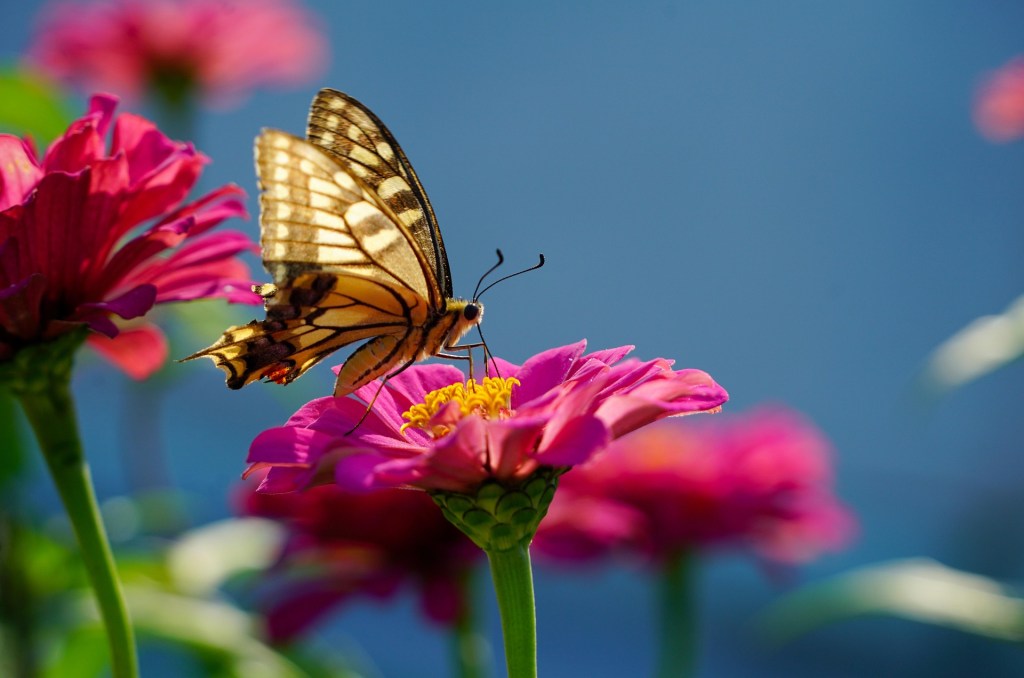
Butterflies and moths, grouped under the order Lepidoptera, form the second-largest insect group, with over 160,000 named species. The real count likely doubles that, hidden among the undiscovered and uncertain. Butterflies stand out because their vibrant colors draw crowds of researchers and volunteers worldwide, creating unusually detailed population records compared to other insects. Take Singapore: while we grasp little about the city-state’s overall insect health, we know nearly half its native butterfly species vanished over 160 years, likely from lost vegetation.
A Butterfly’s Fragile Journey
A butterfly’s life begins when a female lays eggs on a carefully chosen plant—caterpillars are picky eaters. Two to ten days later, the caterpillar chews free, then devours leaves like a nonstop conveyor belt. It outgrows its skin multiple times, each phase called an “instar.” Eventually, it spins a silk chrysalis (or cocoon for moths), where its body breaks down and rebuilds into a butterfly. In tropical regions, this metamorphosis wraps up in about four weeks; some species take up to two years.
This delicate cycle hinges on specific plants and habitats, making butterflies barometers for ecosystem health.
Tech Fixes Won’t Save Us
As food supplies dwindle and wildlife crashes, expect cascading pain for the poor and vulnerable in unequal societies—perhaps fueling resentment and nationalism. We’ll likely chase tech miracles: giant CO2-suckers for climate change, quick vaccines for pandemics, or Elon Musk’s kid-sized submarine for Thai cave rescues. Why not invent robot bees if real ones fade?
Vertical farming offers promise—stacked, year-round crops in LED-lit warehouses and hydroponic containers, skipping soil and pesticides. Pair it with robotic pollinators if insects bail.
Eat Insects to Save Them?
Western diets demand rethinking. A third of cropland feeds livestock, which claim a quarter of ice-free land, turning vast areas into biodiversity deserts. Swap in mealworms and crickets: protein-packed, they breed massively in small spaces, easing pressures from climate change, chemicals, and land loss.
Insects’ Unprecedented Peril
Insects have survived Earth’s cataclysms as ultimate survivors, filling every niche. But a December 31, 2020, paper amid the sixth mass extinction warns otherwise. Past events, even the Permian “great dying” 250 million years ago (killing 90% of species), caused insects mostly “faunal turnover,” not devastation. This crisis is different—unprecedented in their history. “This is not insects’ sixth mass extinction—in fact, it may become their first,” the paleobiologists noted.
A Human Wake-Up Call
By flattening landscapes, poisoning soils, tweaking the atmosphere, and crafting biological deserts for progress and beauty, we’re running a dangerous experiment. Insects predate us and will likely outlast us, but don’t bet on humanity sailing through unscathed. We need their diversity far more than they need us. The insect crisis is our self-interested emergency.
Source : The Insect Crisis: The Fall of the Tiny Empires That Run the World by Oliver Milman
Goodreads : https://www.goodreads.com/book/show/58100655-the-insect-crisis
Read the Previous Article in the Series :






 Thinking Beyond Science
Leave a comment