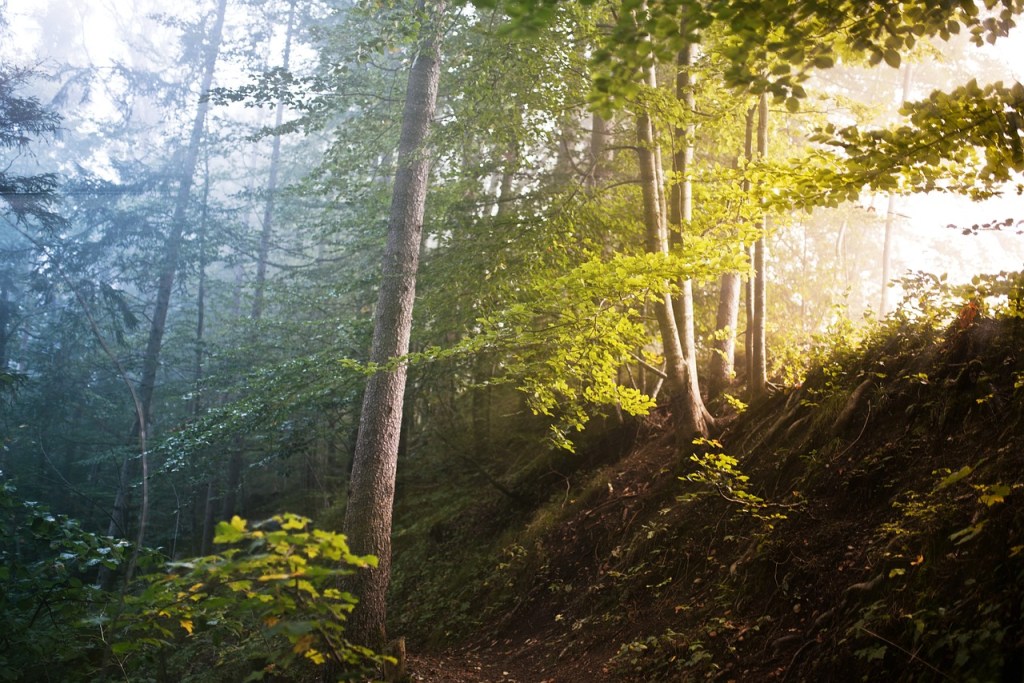
It is a little ironic for us that a man who writes about trees in a simpatico vein is German, because we owe our stern forestry plantation system in India to German foresters who first organized and instituted the forest department and its policies in India and Burma in the mid-nineteenth century. Britain had no tradition of ‘scientific forestry’ in the nineteenth century. France and Germany did, and it would have been too much to expect that Britain would ask the French to come in to advise them about anything!
It was German foresters who were invited in and taught us that the ideal scientific forest was an even-aged forest, felled by rotation, stocked only with ‘desirable’ species, with everything else cut out as dross. It is a silvicultural system and a plantation mindset that caused enormous damage to our mixed forests and, in many ways, we still have not been able to shake off the worst aspects of thinking of forests as commercial plantations.
One reason that many of us fail to understand trees is that they live on a different timescale than us. One of the oldest trees on earth, a spruce in Sweden, is more than 9500 years old. That’s 115 times longer than the average human lifetime. Creatures with such a luxury of time on their hands can afford to take things at a leisurely pace. The electrical impulses that pass through the roots of trees, for example, move at the slow rate of one third of an inch per second.
Trees need to communicate, and electrical impulses are just one of their many means of communication. Trees also use the senses of smell and taste for communication. If a giraffe starts eating an African acacia, the tree releases a chemical into the air that signals that a threat is at hand. As the chemical drifts through the air and reaches other trees, they ‘smell’ it and are warned of the danger. Even before the giraffe reaches them, they begin producing toxic chemicals. Insect pests are dealt with slightly differently. The saliva of leaf-eating insects can be ‘tasted’ by the leaf being eaten. In response, the tree sends out a chemical signal that attracts predators that feed on that particular leaf-eating insect.
The most astonishing thing about trees is how social they are. The trees in a forest care for each other, sometimes even going so far as to nourish the stump of a felled tree for centuries after it was cut down, by feeding it sugars and other nutrients, and so keeping it alive. Only some stumps are thus nourished. Perhaps they are the parents of the trees that make up the forest of today.
A tree’s most important means of staying connected to other trees is a ‘wood wide web’ of soil fungi that connects vegetation in an intimate network that allows the sharing of an enormous amount of information and goods. Scientific research aimed at understanding the astonishing abilities of this partnership between fungi and plant has only just begun.
The reason trees share food and communicate is that they need each other. It takes a forest to create a microclimate suitable for tree growth and sustenance. So it’s not surprising that isolated trees have far shorter lives than those living connected together in forests. Perhaps the saddest plants of all are those we have enslaved in our agricultural systems.
The reason trees share food and communicate is that they need each other. It takes a forest to create a microclimate suitable for tree growth and sustenance. So it’s not surprising that isolated trees have far shorter lives than those living connected together in forests. Perhaps the saddest plants of all are those we have enslaved in our agricultural systems.
Living cells must have food in the form of sugar, they must breathe, and they must grow, at least a little. But without leaves -and therefore without photosynthesis-that’s impossible. No being on our planet can maintain a centuries-long fast, not even the remains of a tree, and certainly not a stump that has had to survive on its own.
A tree is not a forest. On its own, a tree cannot establish a consistent local climate. It is at the mercy of wind and weather. But together, many trees create an ecosystem that moderates extremes of heat and cold, stores a great deal of water, and generates a great deal of humidity. And in this protected environment, trees can live to be very old.
To get to this point, the community must remain intact no matter what. If every tree were looking out only for itself, then quite a few of them would never reach old age.
The average tree grows its branches out until it encounters the branch tips of a neighboring tree of the same height. It doesn’t grow any wider because the air and better light in this space is already taken. However, it heavily reinforces the branches it has extended, so you get the impression that there’s quite a shoving match going on up there.
But a pair of true friends is careful right from the outset not to grow overly thick branches in each other’s direction. The trees don’t want to take anything away from each other, and so they develop sturdy branches only at the outer edges of their crowns, that is to say, only in the direction of ‘non-friends’. Such partners are often so tightly connected at the roots that sometimes they even die together.
Source : The Hidden Life of Trees: What They Feel, How They Communicate: Discoveries from a Secret World by Peter Wohlleben, Tim Flannery (Foreword), Jane Billinghurst (Translator)
Goodreads : https://www.goodreads.com/book/show/28256439-the-hidden-life-of-trees






 Thinking Beyond Science
Leave a comment