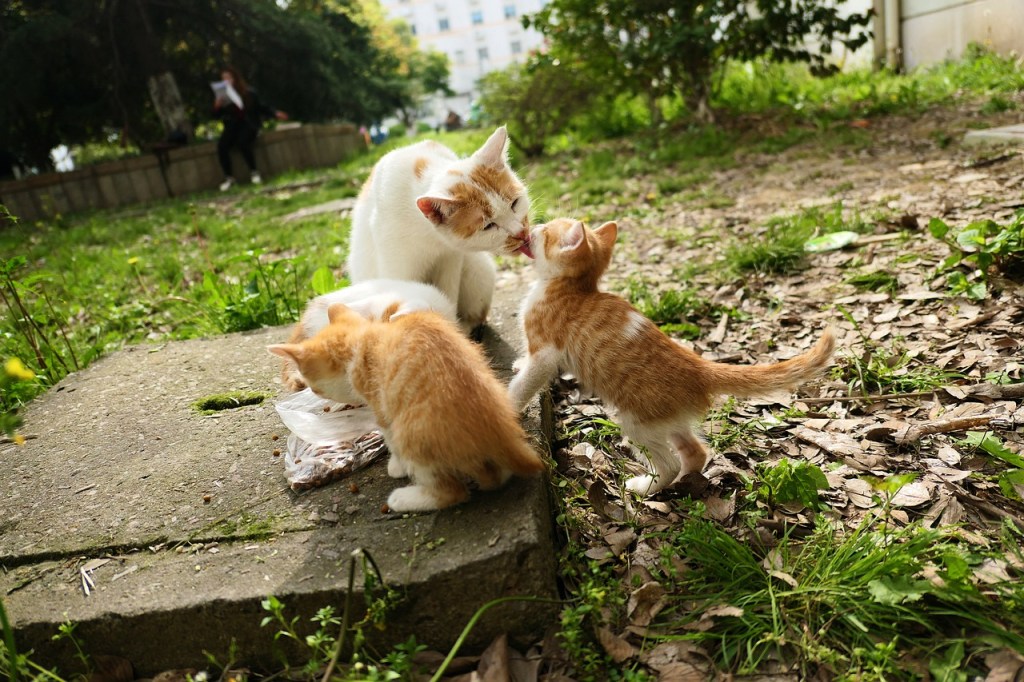
Shortly before a child is born, the hormone oxytocin flows through the mother’s system, which helps her develop a strong bond with her child. In addition, large quantities of endorphins – one of the so-called ‘feel-good’ chemicals – are released, which dull pain and reduce anxiety. This cocktail of hormones remains in the mother’s bloodstream after the birth of her child, ensuring that the baby is welcomed into the world by a mother who is relaxed and in a positive mood. Nursing stimulates further production of oxytocin, and the mother-child-bond intensifies. The same thing happens in many animals, including the goats that my family and I keep at our forest lodge. Goat mothers also produce oxytocin.
A mother goat starts getting acquainted with her kids when she licks off the mucus that covers her babies after birth. The clean-up process intensifies their bond, and as the mother goat bleats softly to her children, her offspring reply in thin, reedy voices and the vocal signatures are imprinted in both mother and kids.
If a mother in hospital is separated from her newborn baby for an extended period of time, the maternal bond becomes more difficult to establish. The situation is not as dramatic as it is with goats, because humans are not totally dependent on hormones and can learn how to love. If we were like goats, adoptions would never work out, because adoptive mothers often meet their children years after their birth. Adoption, therefore, is the best opportunity we have for investigating whether maternal love is more than just an instinctive reflex and something that can be learned.
In the end, it doesn’t really matter how much our intellect is consciously in control. Despite the fact that a surprising number of our reactions are probably instinc-tive, our experiences of fear and grief, joy and happiness are not at all diminished by being triggered instinctively, instead of being actively instigated. Their origin doesn’t reduce their intensity in any way. The point is that emotions are the language of the unconscious and, in day-to-day life, they prevent us from sinking beneath an overwhelming flood of information. The pain in your hand when you put it on a hot element allows you to react immediately. Feeling happy reinforces positive behaviors. Fear saves you from embarking on a course of action that could be dangerous. Only the relatively few problems that actually can, and should, be solved by thinking them through make it to the conscious level of our brain, where they can be analyzed at leisure.
Emotions are linked to the unconscious part of the brain, not the conscious part. If animals lacked consciousness, all that would mean is that they would be unable to have thoughts. But every species of animal experiences unconscious brain activity, and because this activity directs how the animal interacts with the world, every animal necessarily has emotions. Therefore instinctive maternal love cannot be second-rate, because no other kind of maternal love exists. The only difference between animals and people is that we can consciously activate maternal love (and other emotions); for example, in the case of adoption, where there can be no question of an instinctive bond created between mother and child at birth because first contact often happens much later on. Yet here, too, instinctive maternal love develops over time and the accompanying hormone cocktail flows through the mother’s bloodstream.
In people, it is the limbic system that allows us to experience the full range of joy, grief, fear or desire; and together with other areas of the brain, it facilitates the appropriate physical reactions.” These brain structures are very old in evolutionary terms and so we share them with many mammals: goats, dogs, horses, cows, pigs – the list goes on and on.
Fruit-fly eyes are made up of about 600 individual facets. Because these tiny insects dart around so quickly, their eyes are bombarded by a huge number of images every second. This seems like an impossibly large amount of data to process, but the flies must do this if they are to survive. Anything that moves could belong to a voracious predator. Therefore the fruit fly brain leaves all static images blurry and focuses exclusively on moving objects. You could say that the tiddlers are stripping things down to the bare essentials, an ability that you surely would not have expected these little flies to have. By the way, we do something similar. Our brains don’t allow all the images we see to make it through to our consciousness.
DOMESTIC PIGS ARE DESCENDED from wild boar, which were prized by our ancestors as a source of meat. About 10,000 years ago wild boar were tamed to ensure the delicious animals were available at short notice without us having to go out on dangerous hunts to get them, and they were then bred to better satisfy our require-ments. Despite this interference, modern domestic pigs have retained wild boar’s behavioral repertoire and, above all, their intelligence.
The muscle action of up to 50,000 busy bees creates a decent amount of heat, which must be dissipated so that the hive doesn’t get too hot. This is a complicated task. Worker bees carry in water from the closest source so that it can evaporate and cool the interior of the hive. Thousands of wing-beats circulate air in the hive, creating a cool breeze between the honey-combs. Too much disturbance overwhelms this communal effort. If the hive is attacked from the outside, or if it is handled incorrectly by the bee-keeper while being transported from one place to another, the agitated bees heat up so much that the combs melt and the insects die of heatstroke. The technical German term for this translates as ‘death by buzzing’. The expression comes from the noise the colony makes as the bees panic and beat their wings faster, heating up the hive and causing their own demise.
In the normal course of events, however, the bees’ thermoregulation processes work perfectly. For my hives, most of the year it’s too cold rather than too hot, and creating heat is most important. Vibrating muscles means calories spent, and bees take in the energy they need in the form of honey. Honey is basically a thick, highly concentrated sugar solution with vitamins and enzymes added. Honey serves the same function for bees as fat does for overwintering bears, and just as bears emerge from hibernation much skinnier than they were in the autumn, so the size of bee colonies can shrink tremendously in cold weather. If it gets really cold, the insects huddle together and form a ball. It’s warmest, and therefore safest, in the middle – and, of course, this is where the queen must be. But what about the bees on the outside?
If the exterior temperature drops below 10 degrees Celsius, they would die of cold in just a few hours, so bees inside the ball are kind enough to take it in turns to give the outsiders the opportunity to warm up again in the dense, seething mass.
Source : The Inner Life of Animals: Love, Grief, and Compassion — Surprising Observations of a Hidden World by Peter Wohlleben
Goodreads : https://www.goodreads.com/book/show/37572446-the-inner-life-of-animals
Read Next Article : https://thinkingbeyondscience.in/2025/04/21/discover-how-animals-like-bees-communicate-and-survive/







 Thinking Beyond Science
Leave a comment