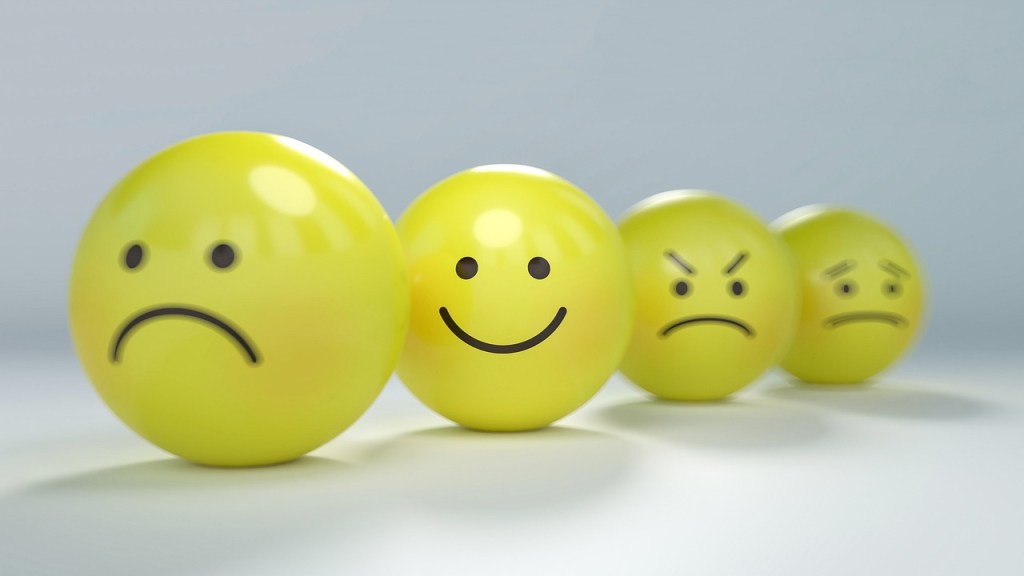
The smallest, most fleeting unit of emotion is an emotional state. Typically lasting only a few seconds, it tends to be triggered by an experience the spike of joy you feel at the macaroni collage your child made you for Mother’s Day, the sense of accomplishment you feel upon finishing a big project at work, the anger you feel over having to work all three days of a holiday week-end, the sadness you feel when your child is the only one in her class not invited to a party. Emotional states can also arise from purely mental activity, such as daydreaming, or introspection, or anticipating the future. But whether they are triggered by real-world experiences or mental ones, emotional states tend to dissipate, each giving way to the next.
A feeling that does persist, and that remains consistent over minutes or hours or even days, is a mood of the “he’s in a bad mood” variety. And a feeling that characterizes you not for days but for years is an emotional trait. We think of someone who seems perpetually annoyed as grumpy, and someone who always seems to be mad at the world as angry. An emotional trait (chronic, just-about-to-boil-over anger) increases the likelihood that you will experience a particular emotional state (fury) because it lowers the threshold needed to feel such an emotional state.
Emotional Style is a consistent way of responding to the experiences of our lives. It is governed by specific, identifiable brain circuits and can be measured using objective laboratory methods. Emotional Style influences the likelihood of feeling particular emotional states, traits, and moods. Because Emotional Styles are much closer to underlying brain systems than emotional states or traits, they can be considered the atoms of our emotional lives, their fundamental building blocks.
In contrast, personality, a more familiar way of describing people, is neither fundamental in this sense nor grounded in identifiable neurological mech-anisms. Personality consists of a set of high-level qualities that comprise particular emotional traits and Emotional Styles. Take, for instance, the well-studied personality trait of agreeableness. People who are extremely agreeable, as measured by standard psychological assessments (as well as their own and that of people who know them well), are empathic, considerate, friendly, gener-ous, and helpful. But each of these emotional traits is itself the product of different aspects of Emotional Style. Unlike personality, Emotional Style can be traced to a specific, characteristic brain signature. To understand the brain basis of agreeableness, then, we need to probe more deeply into the underlying Emotional Styles that comprise it.
Emotional Style comprises six dimensions. Neither conventional aspects of personality nor simple emotional traits or moods, let alone diagnostic criteria for mental illness, these six dimensions reflect the discoveries of modern neuroscientific research:
- Resilience: how slowly or quickly you recover from adversity.
- Outlook: how long you are able to sustain positive emotion.
- Social Intuition: how adept you are at picking up social signals from the people around you.
- Self-Awareness: how well you perceive bodily feelings that reflect emotions.
- Sensitivity to Context: how good you are at regulating your emotional responses to take into account the context you find yourself in.
- Attention: how sharp and clear your focus is
Moving beyond the Big Five, we can look at traits that all of us think of when we describe ourselves or someone we know well. Each of these, too, can be understood as a combination of different dimensions of Emotional Style, though, again, not everyone with the trait will possess each dimension. How-ever, most people will have most of them:
- Impulsive: a combination of unfocused Attention and low Self-Awareness.
- Patient: a combination of high Self-Awareness and high Sensitivity to Context. Knowing that when context changes, other things will change, too, helps to facilitate patience.
- Shy: a combination of being Slow to Recover on the Resilience dimension and having low Sensitivity to Context. As a result of the insensitivity to context, shyness and wariness extend beyond contexts in which they might be normal.
- Anxious: a combination of being Slow to Recover, having a negative Outlook, having high levels of Self-Awareness, and being unfocused (Attention).
- Optimistic: a combination of being Fast to Recover and having a positive Outlook.
- Chronically unhappy: a combination of being Slow to Recover and having a negative Outlook, with the result that a person cannot sustain positive emotions and becomes mired in negative ones after setbacks.
Six dimensions of emotional style. Each of the six dimensions has a spe-cific, identifiable neural signature, a good indication that they are real and not merely a theoretical construct.
Your Resilience style: Can you usually shake off setbacks, or do you suffer a meltdown? When faced with an emotional or other challenge, can you muster the tenacity and determination to soldier on, or do you feel so helpless that you simply surrender? If you have an argument with your significant other, does it cast a pall on the remainder of your day, or are you able to recover quickly and put it behind you? When you’re knocked back on your heels, do you bounce back and throw yourself into the ring of life again, or do you melt into a puddle of depression and resignation? Do you respond to setbacks with energy and determination, or do you give up? People at one extreme of this dimension are Fast to Recover from adversity; those at the other extreme are Slow to Recover, crippled by adversity.
Your Outlook style: Do you seldom let emotional clouds darken your sunny outlook on life? Do you maintain a high level of energy and engagement even when things don’t go your way? Or do you tend toward cynicism and pessimism, struggling to see anything positive? People at one extreme of the Outlook spectrum can be described as Positive types; those at the other, as Negative.
Your Social Intuition style: Can you read people’s body language and tone of voice like a book, inferring whether they want to talk or be alone, whether they are stressed to the breaking point or feeling mellow? Or are you puzzled by even blind to-the outward indications of people’s mental and emotional states? Those at one extreme on this spectrum are Socially Intuitive types; those at the other, Puzzled.
Your Self-Awareness style: Are you aware of your own thoughts and feelings and attuned to the messages your body sends you? Or do you act and react without knowing why you do what you do, because your inner self is opaque to your conscious mind? Do those closest to you ask why you never engage in introspection and wonder why you seem oblivious to the fact that you are anxious, jealous, impatient, or threatened? At one extreme of this spectrum are people who are Self-Aware; at the other, those who are Self-Opaque.
Your Sensitivity to Context style: Are you able to pick up the conventional rules of social interaction so that you do not tell your boss the same dirty joke you told your husband or try to pick up a date at a funeral? Or are you baffled when people tell you that your behavior is inappropriate? If you are at one extreme of the Sensitivity to Context style, you are Tuned In; at the other end, Tuned Out.
Your Attention style: Can you screen out emotional or other distractions and stay focused? Are you so caught up in your video game that you don’t notice the dog whining to go out, until he makes a mess on the floor? Or do your thoughts flit from the task at hand to the fight you had with your spouse this morning or the anxiety you feel about an upcoming presentation for work? At one extreme on the Attention spectrum are people with a Focused style; at the other, those who are Unfocused.
Source : The Emotional Life of Your Brain: How Its Unique Patterns Affect the Way You Think, Feel, and Live–and How You Can Change Them by Richard J. Davidson, Sharon Begley
Goodreads : https://www.goodreads.com/book/show/11950578-the-emotional-life-of-your-brain
Read Next Article : https://thinkingbeyondscience.in/2025/05/19/the-science-of-neuroplasticity-transforming-emotional-styles/








 Thinking Beyond Science
Leave a comment