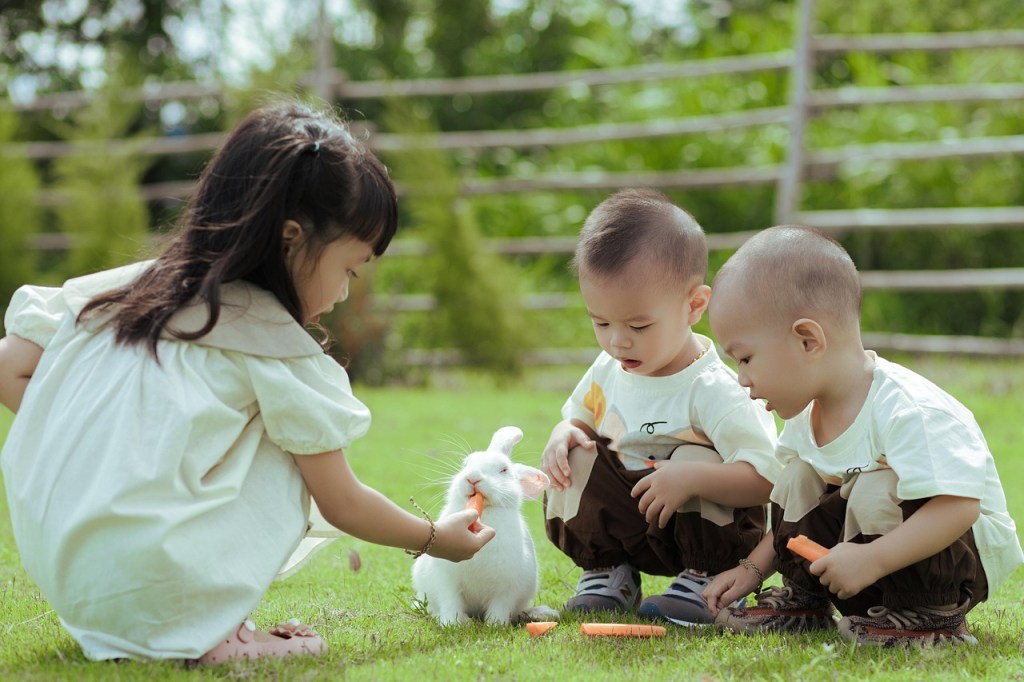
Children learn language by imitation, according to the oldest theories on language development. While studies have indicated that toddlers who imitate the actions of others around them during their first year of life learn to speak more quickly, there is also evidence that imitation alone cannot explain how children learn to speak.
Behavioral Theory:Language, according to behaviourists, may be watched and quantified. Language is uttered in reaction to stimuli that trigger the need to utilise it. Competence in the rules of language is less crucial to a behaviourist than the capacity to speak it; speaking is what makes language real.
Knowledge is a mental state, and a language’s structure does not make it a language; it is the function of uttering words that distinguishes a language from others.
Social Interactionist Theory: This idea emphasises the environment and context in which a language is taught. It concentrates on language pragmatics rather than grammar, which should be addressed later. The beginning speaker and the experienced speaker–whether a kid or an adult, or a second-language learner and a fluent speaker–coexist in this technique in a negotiated relationship where feedback is always possible.
The relevance of the home and cultural environment in early language acquisition is the main attraction of this strategy. Language is not an innate capacity, according to this theory. Rather, it grows out of your ability to negotiate your surroundings.
12-18 Months: Children often say their first words with significance at this age. When a child says “Dada,” for example, the child is actually addressing his father. The child’s vocabulary will expand in the coming months. The child is capable of comprehending far more than they are capable of expressing. They may also follow simple commands such as “Sit-down”.
18 months to 2 years: The majority of children will begin to string two words together to form brief “sentences.” Much of what one says will be understood by the child, and much of what the child says will be understood by one. People who are unfamiliar with the youngster will only understand around half of what the toddler says. Consult the doctor, a child and family health nurse, or another health expert if the kid does not have any words by the age of 18 months.
2-3 years: The youngster most likely speaks in three-to-four-word sentences and is improving at correctly pronouncing words. The child might be able to play and converse at the same time. By the age of three, strangers should be able to understand roughly three-quarters of what the youngster says.
3-5 years: Longer, more complicated discussions regarding the child’s thoughts and feelings are likely. The youngster may also inquire about things, people, and places that are not in their immediate vicinity. ‘Is it raining at Grandma’s house, too? for example. The child will most likely wish to talk about a variety of things, and their vocabulary will continue to expand. The youngster may demonstrate rudimentary grammatical awareness by employing phrases that include words like “because,” “if, “so,” and “when.” They’ll also be able to provide some fascinating stories.
5-8 years: The youngster will acquire more words and begin to understand how the sounds in language interact during the early years of school. As they learn to put words together in new ways and construct different types of sentences, the youngster will become a better storyteller. These abilities also enable the youngster to express his or her thoughts and feelings. The child will be able to hold adult-like discussions by the age of eight years.
Words aren’t the only method to communicate, as any parent knows. Young children communicate with us through pointing, making eye contact, and using body language. Recognizing, supporting, and positively rewarding these language precursors pave the way for future speech and language output.
Even before they learn to point to what they want, children communicate with us in other ways. Language development is, by definition, a changing process. Exploring the many and various paths taken by language can reveal information about the evolution of more general cognitive functions.
Language development research has been especially helpful in understanding the origins of function specialisation as well as the scale and flexibility of cognitive processes during learning.
Children’s language development is significantly influenced by the characteristics of the environment in which they grow. The rate at which a kid develops linguistic skills is determined by his or her experiences. The amount of interaction a child has with his or her parents or caregivers has a big impact on his or her language development.
Cognitive development means how children think, explore and figure things out. It is the growth of information, skills, problem-solving abilities, and attitudes that enable children to think about and comprehend the world around them. Cognitive development includes brain development
Cognitive development includes brain development Attention, short-term memory, long-term memory, logic & reasoning, auditory processing, visual processing, and processing speed are all cognitive capabilities. They are the abilities that the brain employs to think learn, read, remember, focus, and solve issues.
Children gather, sort, and analyse data from their environment, which they then use to improve their perceptual and thinking skills. Early in life, the essential character of intelligence is established, and development entails the accumulation of increasingly more learning experiences.
Morality develops during the course of a person’s life and is influenced by their experiences and conduct when confronted with moral concerns at various stages of physical and cognitive development. In summary, morality is concerned with an individual’s developing sense of what is good and wrong; as a result, young children’s moral judgement and character differ from that of an adult.
Source : Human Psychology: Learners Mindset by Dr. Mukta Goyal
Goodreads : https://www.goodreads.com/book/show/63308362-human-psychology
Read Previous Article : https://thinkingbeyondscience.in/2025/03/07/navigating-adolescence-tips-for-parents/
Read the Next Article in the Series :







 Thinking Beyond Science
Leave a comment