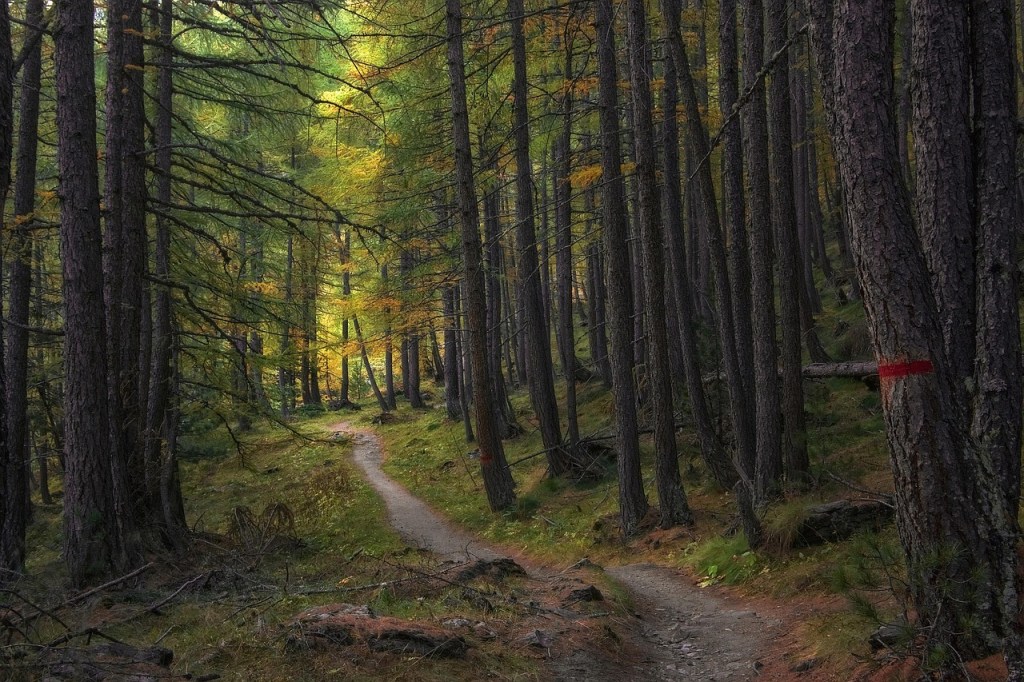
The rate of photosynthesis is the same for all the trees. The trees, it seems, are equalizing differences between the strong and the weak. Whether they are thick or thin, all members of the same species are using light to produce the same amount of sugar per leaf. This equalization is taking place underground through the roots. There’s obviously a lively exchange going on down there. Whoever has an abundance of sugar hands some over; whoever is running short gets help. Once again, fungi are involved. Their enormous networks act as gigantic redistribution mechanisms. It’s a bit like the way social security systems operate to ensure individual members of society don’t fall too far behind.
When trees grow together, nutrients and water can be optimally divided among them all so that each tree can grow into the best tree it can be. If you ‘help’ individual trees by getting rid of their supposed competition, the remaining trees are bereft. They send messages out to their neighbours in vain, because nothing remains but stumps. Every tree now muddles along on its own, giving rise to great differences in productivity. Some individuals photosynthesize like mad until sugar positively bubbles along their trunk. As a result, they are fit and grow better, but they aren’t particularly long-lived. This is because a tree can only be as strong as the forest that surrounds it.
When beeches and oaks put blooming on hold for a number of years, this has grave consequences for insects, as well,especially for bees. It’s the same for bees as it is for wild boar: a multi-year hiatus causes their populations to collapse. Or, more accurately, could cause them to collapse, because bees never build up large populations in deciduous forests in the first place. The reason is that true forest trees couldn’t care less about these little helpers.
Trees maintain an inner balance. They budget their strength carefully, and they must be economical with energy so that they can meet all their needs. They expend some energy growing. They must lengthen their branches and widen the diameter of their trunks to support their increasing weight. They also hold some energy in reserve so that they can react immediately and activate defensive compounds in their leaves and bark if insects or fungi attack.
In the years when the leaves shrivel and fall off, the trees look unusually bare, so it’s no surprise that reports on the condition of forests where the affected trees are growing describe the tree canopy as being in a pitiful state. Because all the trees are going through this process at the same time, to a casual observer the forest looks sick. The forest is not sick, but it is vulnerable. The trees use the last of their energy reserves to produce the mass of blossoms, and to compound the problem, they are left with fewer leaves, so they produce less sugar than they normally do. Furthermore, most of the sugar they do produce is converted into oil and fat in the seeds, so there is hardly any left over for the trees’ daily needs and winter stores–to say nothing of the energy reserves intended to defend against sickness.
When a seed falls from a tree, each species has its own strategy as to when the seed sprouts. So how does that work? If a seed lands on soft, damp soil, it has no choice but to sprout as soon as it is warmed by the sun in the spring, for every day the embryonic tree lies around on the ground unprotected it is in great danger-come spring, wild boar and deer are always hungry. And this is just what the large seeds of species such as beeches and oaks do.
The next generation emerges from beechnuts and acorns as quickly as it can so that it is less attractive to herbivores. And because this is their one and only plan, the seeds don’t have long-term defence strategies against fungi and bacteria. The seeds slough off their protective casings, which lie around on the forest floor through the summer and rot away by the following spring.
Many other species, however, give their seeds the opportunity to wait one or more years until they start to grow. Of course, this means a higher risk of being eaten, but it also offers substantial advantages. For example, seedlings can die of thirst in a dry spring, and when that happens, all the energy put into the next generation is wasted. Or when a deer has its territory and main feeding ground in exactly the spot where the seed lands, it takes no more than a few days for the seedling’s tasty new leaves to end up in the deer’s stomach.
If some of the seeds do not germinate for a year or more, then the risk is spread out so that at least a few little trees are likely to make it.
Every five years, a beech tree produces at least 30,000 beechnuts (thanks to climate change, it now does this as often as every two or three years, but we’ll put that aside for the moment). It is sexually mature at about eighty to 150 years of age, depending on how much light it gets where it’s growing. Assuming it grows to be 400 years old, it can fruit at least sixty times and produce a total of about 1.8 million beechnuts. From these, exactly one will develop into a full-grown tree -and in forest terms, that is a high rate of success, similar to winning the lottery. All the other hopeful embryos are either eaten by animals or broken down into humus by fungi or bacteria.
Source : The Hidden Life of Trees: What They Feel, How They Communicate: Discoveries from a Secret World by Peter Wohlleben, Tim Flannery (Foreword), Jane Billinghurst (Translator)
Goodreads : https://www.goodreads.com/book/show/28256439-the-hidden-life-of-trees
Read Previous Article in Series :






 Thinking Beyond Science
Leave a comment