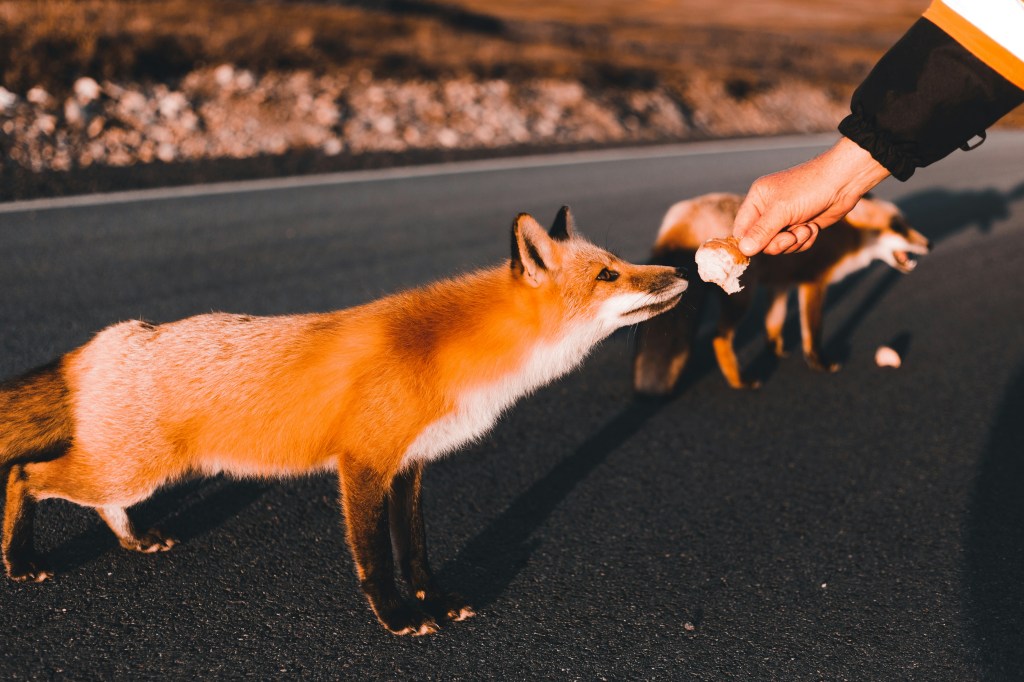
If you happen to keep a pet fox, their faces in particular may contain fox tapeworm eggs. These eggs are as tiny as specks of dust, and after such a fecal bath they shower down from the fur of your beloved pet – likely as not, all over the living room. You then take the place of the mouse that was the eggs’ intended host. The developing larvae settle in internal organs and make the mouse sick, to slow it down. Foxes then catch the slow-moving mice, which completes the worms’ life cycle. But not, of course, if you are acting as the intermediary host instead. People get a severe infection that can be difficult to cure, depending on how far the worm infestation has spread.
Apart from the smell, it is also just as important for all animals to be clean. Like us, they feel very uncomfortable if they have faces or other dirt stuck to them. It’s probably the reaction of their fellow animals that reinforces their feeling of discomfort. An animal with a dirty backside signals that it’s probably ill and that’s why it has diarrhea. Other animals don’t want to catch something nasty and certainly don’t want to mate with a soiled partner.
The animals find it much easier to walk along them, as you can see from the numerous tracks pressed into soft spots on the surface. And where people aren’t there to help out, the animals make these cross-country routes for themselves. They are, mind you, considerably narrower, measuring only the width of the animal. There’s no ordered plan. One day the lead sow in a herd of wild boar finds her way through the underbrush. The other boar follow, and the grass and other greenery are soon trampled down. Next time the pigs pass there are still traces of this faint track, and it’s a little easier to walk along it. Over the course of time and after years of use, the path looks like a footpath trampled down by people: all the vegetation has been crushed by trotters and the path shows up as a narrow strip of bare earth. Knowledge of these easily walkable cross-country routes is passed down from generation to generation, unless humans come along and obstruct them.
Also, animals’ cross-country routes also offer disadvantages to those using them, because the heavy foot traffic attracts uninvited guests. More prevalent than the predators that lurk along the paths waiting to make a meal of careless travellers are small critters waiting for their next meal: ticks. Ticks are members of the mite family, and they depend on meals of blood. Because they move very slowly, they have to wait for their victims to come to them. And where better to wait than along a well-travelled path? Here, ticks cling to stalks of grass, twigs or leaves hanging within range of the backs of deer or wild boar, waiting for the scent of mammalian breath or sweat and the vibrations caused by approaching hooves or trotters. So if you’re wandering through the woods in summer, it’s best to avoid cross-country routes frequented by game. In winter, it’s not a problem, because ticks are not active at low temperatures. And there are more stowaways than just ticks lying in wait along these game routes.
People are visual animals, and we hunt by sight. And so the goal of our potential prey has to be to disappear from view. If we hunted by scent, then perhaps over generations animals would have become almost odorless. If we hunted by hearing, they would perhaps have become extremely quiet. Instead, they endeavor to remove themselves from our field of vision. The most important element here is the time of day. It’s quite simple: because we see barely anything in the dark, our prey evade us by being active at night. We think deer and wild boar are naturally nocturnal, but they’re not. They need food at regular intervals around the clock.
But instead of spending their days in meadows or along the edges of woodlands, which would be their normal behavior, they spend their days feeding out of sight in the underbrush or deep woods. They feel confident enough to leave their hiding places only when darkness falls – the time when people are optically challenged. It is only the very hungry or careless youngsters who venture out earlier and dare to enter areas where hunting blinds loom over the landscape. We euphemistically call these ‘raised hides, but to deer they are death-traps where their worst enemies perch and deal sudden death with a bang and a puff of smoke.
An animal that has seen a family member collapse covered in blood, or has experienced fear and rising panic deep in its bones, will pass these experiences on, probably over many generations. Researchers have concluded that this transfer happens even in the absence of language, for – as reported back in 2009 – fear is not only felt in the bones, it is also expressed in the genes.” The Max Planck Institute of Psychiatry in Munich discovered that during traumatic experiences particular chemical markers (methyl groups) get attached to genes. They work like switches and alter the activity of the genes. According to the discoveries researchers made using mice, this means that behaviour can be changed for life. The research also predicts that, thanks to these altered genes, certain patterns of behaviour can be inherited.
Source : The Inner Life of Animals: Love, Grief, and Compassion — Surprising Observations of a Hidden World by Peter Wohlleben
Goodreads : https://www.goodreads.com/book/show/37572446-the-inner-life-of-animals
Read Previous Article in the Series :
Read the Next Article in the Series :





 Thinking Beyond Science
Leave a comment