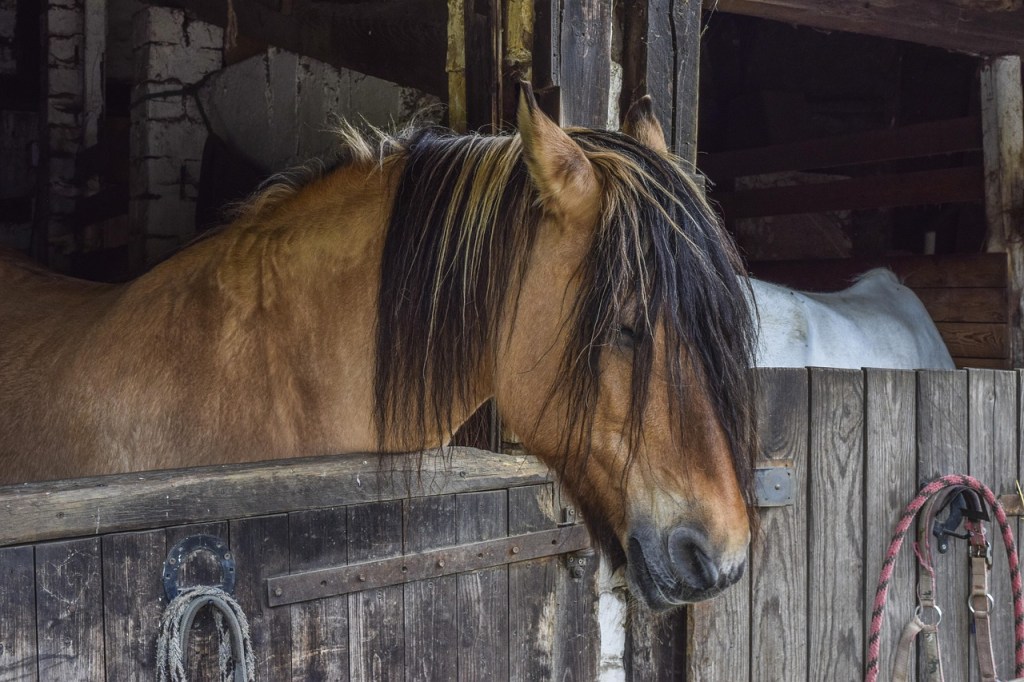
Sleep is one of nature’s quiet miracles—a time when every species, from humans to horses, retreats inward to restore itself. Yet, sleep is far from uniform. For us, sleep unfolds in carefully layered phases, some deep and dream-filled, others light and transitional. Horses, on the other hand, experience it differently. Their true deep sleep lasts just a few minutes and happens when they lie flat on their sides, legs stretched out and twitching as though galloping through invisible pastures. For the rest of the day, they mostly doze while standing, resting one hind leg at a time thanks to a special joint that locks in place to prevent collapse.
This image of a horse—standing silently in half-sleep, or lying down lost in dreams—captures something ancient about coexistence in nature. Each creature follows rhythms finely tuned to the world around it. The REM phase, when our eyes flicker behind closed lids and dreams take shape, is just one universal thread connecting us to countless other species that dream in their own ways.
Shadows of Light: How Human Progress Disrupts Natural Rhythms
But the harmony of these rhythms is under threat. Every day, humanity reshapes the planet, consuming almost 80 percent of Earth’s land surface through cities, roads, and agriculture. For animals whose senses evolved for forests and natural light, our modern environment can be deeply confusing. Artificial light, for instance, masks the stars that once guided nocturnal travelers. In Europe, half the night sky now glows with light pollution—even small towns brighten the horizon for dozens of kilometers.
For moths, starlight and moonlight serve as cosmic compasses. A full moon on their left helps them fly in a straight line toward the west. But a garden lamp can trick them into endless circles. The same glow that comforts us distorts their night, leading them astray.
Lessons from Horses and Humans
Horses offer another perspective on how closely our lives intertwine with nature. In traditional logging, they work beside humans in remarkable partnership—responding not to force, but to voice. A few soft sounds, gestures, and murmured phrases guide these powerful animals, showing a bond built on understanding rather than domination. This connection runs deep: just as our ancestors adapted to drink the milk of their domesticated cows and goats—an evolutionary twist that gave rise to lactose tolerance—our shared life with horses, dogs, and other animals has shaped who we are.
In fact, this coevolution spans millennia. Forty thousand years of companionship with dogs, for example, may have refined not only our behavior but our empathy. Yet even today, many resist acknowledging that animals can feel joy, pain, or sorrow. Some scientists and policymakers still defend practices that treat living beings as unfeeling resources—castrating piglets without anesthesia, confining factory-farmed animals, or hunting wildlife for sport.
Finding Our Way Back
If sleep reveals anything, it is that every living being—human or animal—requires quiet, safety, and respect for its natural rhythms. To restore those conditions, we must rethink how we inhabit the planet. Every patch of green preserved, every dark sky protected, and every gentle interaction with another species brings us closer to harmony.
Perhaps when we honor the sleeping horse or the wandering moth, we awaken something vital in ourselves—the memory of a world once shared more peacefully between all who dream.
Source : The Inner Life of Animals: Love, Grief, and Compassion — Surprising Observations of a Hidden World by Peter Wohlleben
Goodreads : https://www.goodreads.com/book/show/37572446-the-inner-life-of-animals
Read the Previous Article in the Series :




 Thinking Beyond Science
Leave a comment