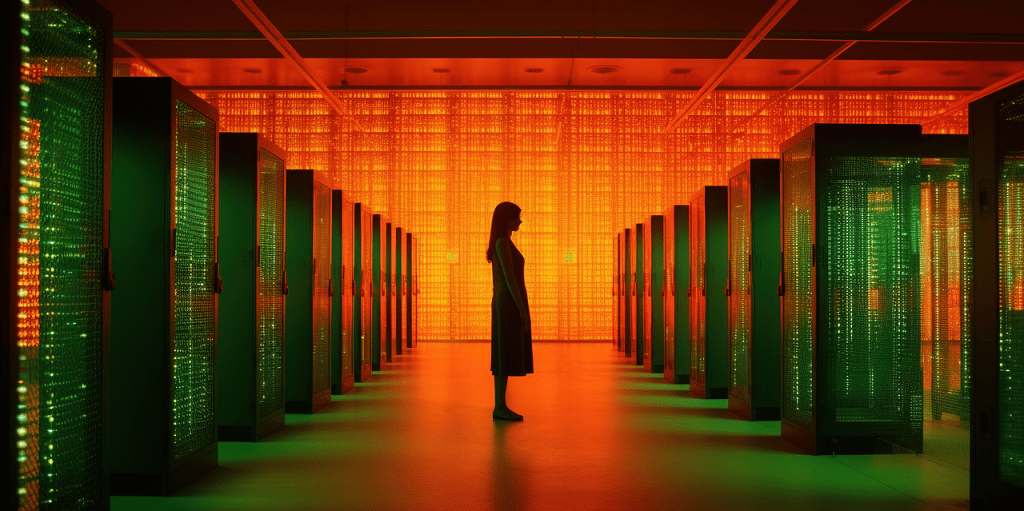
The world now produces over 2.5 quintillion bytes of data every single day—about 2,500,000,000,000 megabytes—and that flood is still growing by roughly 60% each year. Facebook alone deals with at least 2.7 billion items of content and 600 terabytes of data daily, while computation has exploded in parallel, with global computing capacity adding exaflops at a pace that would have been unimaginable just a decade ago. By the time this is read, those numbers will already be higher, because we are no longer in an age of scarcity, but of overwhelming abundance.
From scrolls to sextillions
For most of human history, information was rare, fragile, and hard to come by. Books were written on clay tablets, papyrus, or vellum, laboriously copied by hand in isolated centres of learning. Even after the printing press, books remained a relative luxury, and finding, let alone verifying, data was incredibly difficult. The Library of Alexandria stood as the greatest store of knowledge in antiquity, a vast collection of hundreds of thousands of scrolls that represented the pinnacle of learning for a civilisation that spanned continents. It was here that scholars discovered the heliocentric nature of the solar system centuries before Copernicus, making its destruction not just a loss of books, but of irreplaceable, unique knowledge.
That world was defined by limits: copying was slow, materials were scarce, and information was a precious resource. Today, the opposite is true. In the past two years alone, humanity has produced more data than in all of recorded history before that, and the rate keeps accelerating. If the ones and zeros of just one megabyte were written out in longhand, the line would stretch five times longer than Mount Everest is high. We have moved from a world where information was hard to create and preserve, to one where the problem is no longer scarcity, but excess.
The paradox of plenty
For two centuries, modern economies have celebrated growth, productivity, and “more”: more people, more resources, more data, more everything. That drive has delivered astonishing gains: clothes at prices lower than a cup of coffee, the world’s information in our pockets, and technologies that let us reshape the planet and reach into space. Yet, in the West, this abundance has created a new set of crises.
We no longer go hungry, but we face an obesity pandemic; we generate more data, but also more noise; we are constantly entertained, yet more distracted; we are richer, but more indebted, and we work longer hours. Excess choice is now a daily reality, from hypermarkets so vast that staff need rollerskates to move across them, to endless options in media, utilities, jobs, pensions, and even relationships. In high‑stakes areas like health, finance, and education, choices have proliferated faster than people’s ability to understand them, turning freedom into confusion.
Why “curation” is everywhere
In this context, curation has exploded from a museum term into a cultural buzzword. Once the preserve of specialists selecting art or archives, curation now describes music festivals, shopping malls, websites, news, TED conferences, venture capital portfolios, gala openings, dinner parties, playlists, vacations, fashion shows, and even personal identities. Reporter and investor Robert Scoble calls curation “the next $1bn opportunity,” while figures as different as Barack Obama, Russian power brokers, and Italian prime ministers are described as curators of legacies or systems.
Curation provokes both enthusiasm and eye‑rolling because it is rarely seen in its full context. It became a buzzword not because it is trendy, but because it offers one answer to the problems caused by having too much. For two hundred years, capitalism has championed creativity, growth, and relentless productivity, always wanting more. Now, it is becoming clear that we are overloaded, and that the real challenge is not to produce more, but to make sense of what already exists.
Curation as the new value
Curation, in its simplest form, is the act of selecting, refining, and arranging to add value. It is how we live in a world where the main problems are about having too much, not too little. In a world no longer dominated by scarcity, value has shifted from primary production to solving complexity, cutting down noise, and offering tailored, appropriate choices.
This is why curation is moving from an afterthought to a prime USP. Rather than just putting out more products, mature creative industries are becoming more choosy as a growth strategy. Retailers are realising that their value lies not in stocking and shifting everything, but in curating what they offer and how they guide customers. Consumers, too, no longer blindly accept whatever is on offer; they want to be curators of their own lives, from their look and mini‑breaks to their TV on a night in.
The roadmap for a world of excess
All of this is part of what some call “the Great Disruption”: a post‑digital era of information abundance, pervasive connectivity, and the blurring of offline and online worlds. Culture, business, and relationships are moving into this new realm, production and distribution patterns are changing, and new economies are centred on experiences, luxury goods, and high‑end services, all underpinned by a craving for simplicity.
Curation works because it follows these major trends: it argues that market forces will push us toward doing less, whittling down excess, and valuing simplicity in a complex world. Where business used to want more, now it should want better; where abundance was the goal, now it is the problem to be solved. Many businesses—from bars to banks—are already in the business of doing less, but this is only just beginning.
In order to prosper, we will have to curate far more effectively, appreciating the value of less, of clarity, and of thoughtful selection. Understood and used correctly, curation can be an essential principle for the coming decades, helping organisations unlock stores of value they never knew they had in saturated markets and a ferociously competitive climate.
Source : Curation: The Power of Selection in a World of Excess by Michael Bhaskar
Goodreads : https://www.goodreads.com/book/show/30512491-curation







 Thinking Beyond Science
Leave a comment