Imagine being just a centimeter long at the start of week six of pregnancy—a tiny, tail-sporting wonder with a face emerging from neck folds and eyes as dark specks. Your head leans against your chest, where a red heart bulges out. That long tail? It’s stopped growing and will soon vanish, much like in whales, which evolved from four-legged mammals (their closest kin: the hippopotamus). Whales’ forelimbs become flippers, hindlimbs shrink to bony stumps, and your tail follows suit, dwindling to a tailbone.
Your skeleton begins as cartilage—a tough mix of cells, protein fibers, and shock-absorbing jelly. Cells start proximally, building the upper arm bone first, then forearm bones, and finally fingers. Legs follow the same inside-out pattern. Precision comes from chemical signals dosing cells with location data. Fingers start webbed but separate in week eight via orchestrated cell suicide: future finger cells emit death signals, neighbors degrade proteins, and scissor proteins shred DNA.
By week’s end, toes emerge, your tail nearly gone, facial wrinkles smooth, a short fattened nose and tiny ears appear, with pointy elbows and knees on stubby limbs. This cartilage prototype won’t ossify until month three—a gradual process. At birth, bones stay soft for squeezing through the birth canal; kneecaps remain cartilage until age three, full replacement lingering into your twenties.
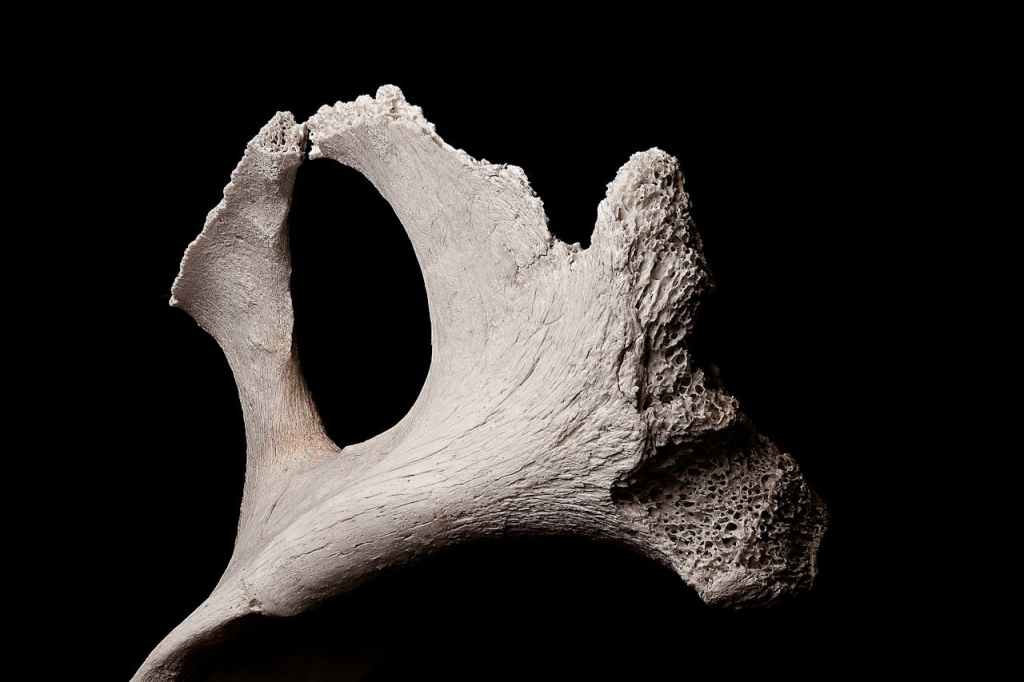
Ossification kicks off at the bone’s center: cells swell into giants, die, and hollow a cavity for bone marrow. Your liver and spleen, temporary blood factories, hand off duties as marrow ramps up. It churns out stem cells that become platelets for clotting wounds, white blood cells to fight bacteria, and red blood cells for oxygen—replacing two million per second in every person, nonstop.
Surrounding cells then harden the jelly into mineralized bone: calcium and phosphate crystals bind protein fibers, yielding strong, elastic shock-absorbers. Thin tendrils from bone cells link to blood vessels via ducts, keeping them nourished amid minerals. Bones live and remodel daily—every decade, your entire skeleton renews, with builder cells adding and eaters removing old material.
This adaptability shines (and falters) in space: astronauts lose bone mass fast in weightlessness, as strain-free bones cut builder cells while eaters persist, turning skeleton porous and fracture-prone. Bones store calcium too, sacrificing density if heart or nerves demand it—better porous bones than a stopped heart.
Your skeleton’s story starts small but powers a lifetime of motion, repair, and resilience. From embryonic tail to cosmic challenges, it’s a masterpiece of evolution and engineering.
Source : The Making of You: A Journey from Cell to Human by Katharina Vestre
Goodreads : https://www.goodreads.com/book/show/42121353-the-making-of-you
Read the Next Article in the Series :
Read the Previous Article in the Series :




 Thinking Beyond Science
Leave a comment