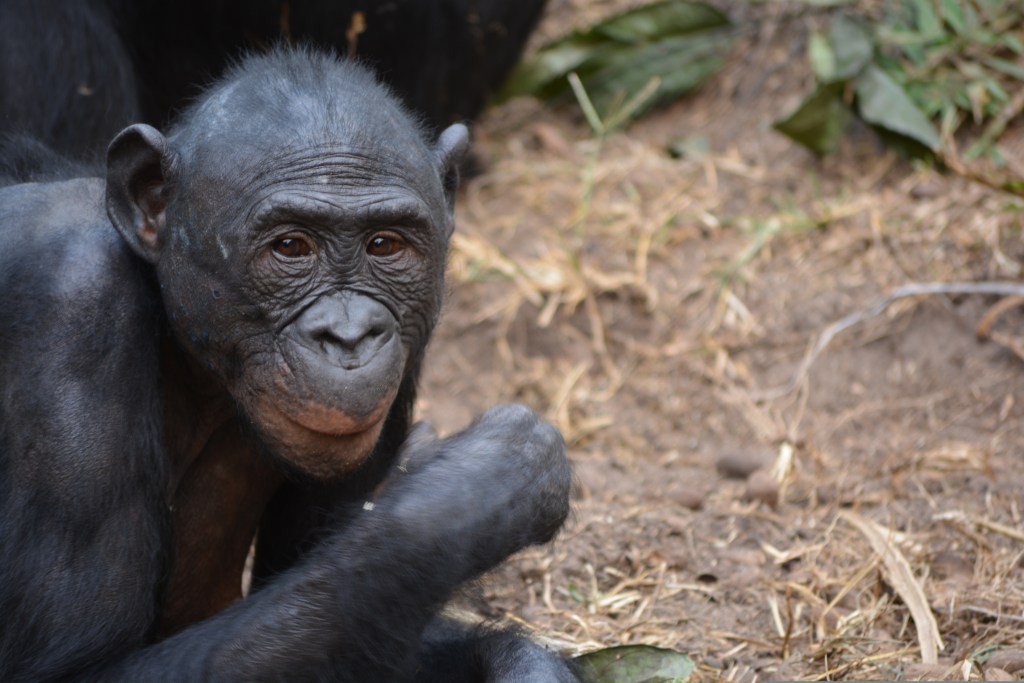
One or two million years ago, the bonobo’s chimp-like ancestor became isolated south of the Congo River. Unlike the population on the other side, these primates had a tremendous advantage: a lack of gorillas. The two species compete for herbs that form their diet when fruit is scarce.
Like chimpanzees, bonobos share 98 percent of their DNA with humans, making these two ape species our closest living relatives. However, due to their remote habitat, little was known about bonobos until recently. They differ from chimpanzees with smaller heads, higher foreheads, pink de-pigmented lips, smaller canines, and a flatter, more open face. The white patch on their tails that chimpanzees lose after becoming adults persists in bonobos throughout their lives.
Compared to chimpanzees, aggression is relatively rare in bonobo society. Unlike male-dominated chimpanzee groups, females rule in bonobos, with the alpha female at the top. Since females are not as physically strong as males, they dominate by working together to punish overly aggressive males. Though wild male bonobos are much less aggressive than chimpanzees, female bonobos are more aggressive than their chimpanzee counterparts. This ability to control male behavior gives them freedom to choose mates—and they prefer gentler, more peaceful males. Over time, this may have created a friendlier society. All in all, bonobos seem a prime example of a self-domesticated species.
How Cuteness Fuels Care and Evolution
Unlike ape babies, human infants aren’t as cute at birth as they become six months later. Yet chemical changes in mothers’ brains—such as increased oxytocin (the “hug hormone”) and prolactin (linked to milk production)—spark fierce attachment to newborns.
Fathers and others near newborns also show elevated oxytocin and prolactin, though to a lesser degree. MRI scans of new fathers reveal brain changes in areas tied to rewarding attachment, empathy, and caretaking. Newborns thus receive care from mothers and relatives even before peak cuteness.
Being pleasingly plump is one cute trait newborns use to appeal to adults, alongside round heads and fleeting “fairy smiles” before directed social smiles at four or five weeks. The real power of cuteness ramps up later. From around four months, infant laughter prompts oxytocin release—even in non-parents. Peak cuteness hits at five to six months (persisting for years), when babies babble spontaneously. This, with laughter and other traits, draws positive attention and prompts adults to see them as independent psychological agents, creating a positive reinforcement loop.
Self-Domestication and the “Cuteness Selection” Hypothesis
As highly aggressive adults were weeded from the gene pool and domestication began, cuter babies likely received more care, speeding the process. Evidence mounts for the human self-domestication hypothesis—that we became tame evolving into Homo sapiens—but it remains unproven. Some scientists doubt the “domestication syndrome” due to inconsistency across species, question neural crest cells’ role in taming, or suggest aggression control and social emotions arose from sources like communal music-making.
Cuteness may have shaped us human via two paths: females preferring calmer mates, or caretakers favoring cuter, social babies. Both emphasize cute, affiliative behavior beyond looks. Linguist Stephen Levinson calls this tandem process “cuteness selection.” He argues our neotenous (youth-retaining) appearance and empathic nature could stem from cuteness selection—even without full domestication—over a longer timescale. This preference for the adorable, friendly, and cooperative turned us into “mind-readers” grasping others’ intentions, paving the way for language.
Cuteness in Modern Culture and the Brain
Traditional adulthood markers like steady jobs, marriage, and children are fading amid globalization’s precarity. Many postpone family to prolong youth, blurring child-adult boundaries. Adults embrace youthful looks and playfulness—college students wear pajamas to class, seniors hit Disney World.
Like cuteness, anthropomorphism lets us see objects or creatures as thinking beings worthy of empathy. Globally, cuteness ties to immaturity and plasticity: young children are cute because their future is unclear. Humans’ slow maturation keeps us adaptable, learning lifelong. Cuteness signals this youthful edge in shaky economies—but risks accusations of infantilism.
Fan conventions feature cosplay (costume + play, from Japan), with “furries” donning head-to-toe animal costumes—unique, cute, and unlinked to media franchises.
Neuroscientist Morten Kringelbach studies cute objects’ brain effects. Cuteness engages all senses, sparking rapid activity that grabs attention before recognition. Child-schema traits jump the brain’s queue, activating the orbitofrontal cortex for pleasure and reward. It then triggers empathy, compassion, caregiving, and playful networks—humanizing people and objects. Kringelbach sees cuteness as a “Trojan horse,” opening shut brain doors.
This metaphor cuts both ways: positive for us, disastrous for Troy’s inhabitants. With robotics, AI, and VR wielding cuteness, will we be the clever Greeks—or the duped Trojans?
Source : Irresistible: How Cuteness Wired our Brains and Conquered the World by Joshua Paul Dale
Goodreads : https://www.goodreads.com/book/show/104386157-irresistible
Read the Previous Article in the Series :





 Thinking Beyond Science
Leave a comment