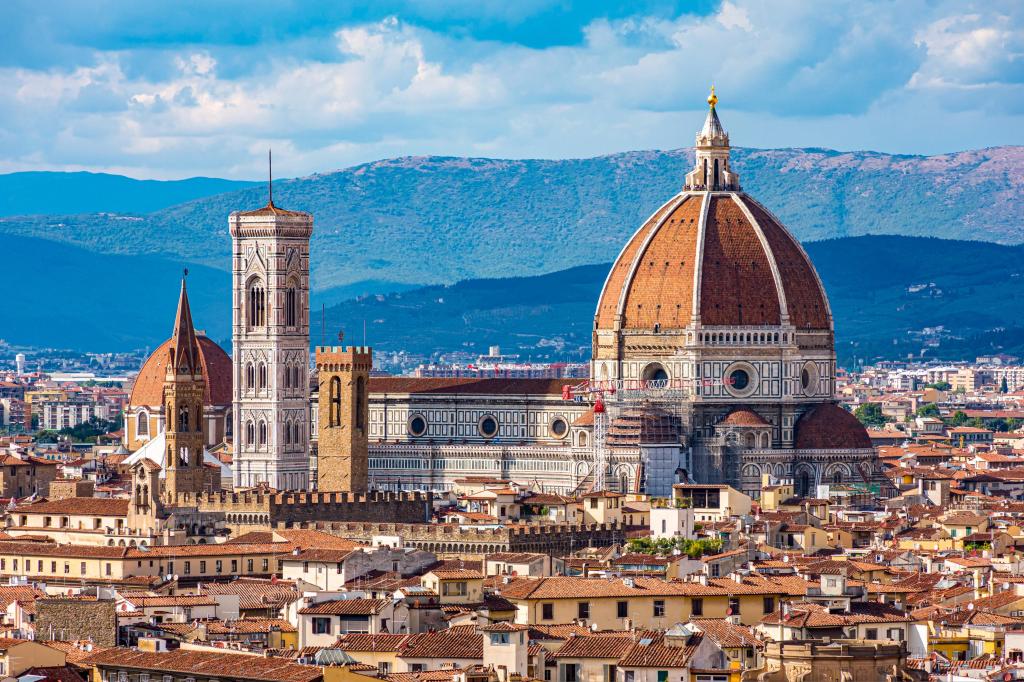
Not since Athens has one city produced so many brilliant minds and good ideas in such a brief time. We know what the Renaissance—literally “rebirth”—was, thanks to its stunning art. But why it happened at all remains a mystery. Was it the discovery of ancient Greek and Roman texts? Relatively enlightened leadership? Something else?
An even bigger puzzle is where it happened. Florence was no natural hub for genius. Swampy, malarial, and plagued by fire, flood, and the bubonic plague, it lacked a port and faced spiteful, bellicose neighbors. Bigger cities like Venice (three times Florence’s population) or militarily stronger Milan should have led the charge. Yet the Renaissance shone brightest in Florence. Why?
To answer, step back to Plato: “What is honored in a country will be cultivated there.” Athens honored wisdom and got Socrates. Rome honored power and built an empire. Florence honored merchants and bankers. Stroll its cobblestoned streets to the Mercato Vecchio, the old market, and picture industrious men at long wooden tables, changing money, arranging loans, cutting deals. (A failed bank’s table got broken—hence “bankrupt,” or “broken table.”) At the Renaissance’s dawn, Florence boasted nearly eighty banks.
One dominated: the Medici bank. From the twelfth century, the Medicis wielded enormous influence, ruling de facto for about fifty years. Originally apothecaries—their coat of arms showed six pills in a circle—they acted like a caffeine dose, revving Florence’s metabolism. Like any drug, their “medicine” brought side effects and dependency risks, but the city thrived.
Great patrons don’t just write checks; they inspire and challenge. The Medicis pushed artists to take risks with wildly reckless bets that now seem wise. They didn’t tolerate innovation—they demanded it. “These people had more money than God,” as one observer notes. “They wanted the best of the best of the best—and when they had that, they sent people out to develop something else.” Like other Florentines, they craved per bellezza di vita—all things enhancing life with beauty. Forget la dolce vita; Florentine life was (and is) beautiful. Patriarch Cosimo de’ Medici got art deeply, observing that “every painter paints himself.” Artists like Donatello divined his desires from the slightest hint.
Cosimo was the Bill Gates of his era: he built a fortune in his first half-life, then gave it away in the second, finding it far more satisfying. He regretted not starting ten years sooner. Money, he knew, is potential energy with a limited shelf life—spend it or watch it deflate like yesterday’s birthday balloon.
Under Medici patronage, artists pursued passions without financial worry. Favorites like Donatello kept cash in a studio basket for anyone to grab. Yet the Renaissance birthed the starving artist: Michelangelo lived monastically on bread and wine, rarely washed, slept in boots, and forsook love for art. “Money was meaningless to him,” a biographer notes. At death, a box under his bed held enough cash to buy Florence. “My delight is in melancholy,” he said—the cry of tortured artists ever since. History’s geniuses often hailed from middle or upper-middle classes: enough for passion, not so much for complacency. As the Prayer of Agur advises: “Give me neither poverty nor riches.”
The Medici dynasty peaked with Cosimo’s grandson, Lorenzo the Magnificent. A skilled statesman, poet, and philosophy lover—like Hangzhou’s poet-rulers—he was above all a talent scout. Dozens of bottege (workshops) dotted Florence, but none matched Andrea del Verrocchio’s. Pudgy and broad-nosed, Verrocchio was a lackluster artist but a superb mentor and businessman—”true eye” in name and practice. Serving top clients like the Medicis, he scouted techniques and talent amid fierce competition.
Every golden age has multipliers—figures whose influence outstrips their output. Cézanne shaped Parisian painters while his work languished; Lou Reed’s Velvet Underground sold few albums, but “everyone who bought one started a band.” Verrocchio was the Renaissance’s Lou Reed. In his paint-splattered workshop, Florence’s greatest honed skills—including a left-handed countryside misfit named Leonardo da Vinci.
The Renaissance was a team effort, not solo stardom. Stars like Michelangelo created for the city, Church, or posterity—not just themselves. Genius is communal, bigger than the individual. Artists lived and worked atop one another organically, “just being” creative without modern team-building buzzwords.
Apprenticeships were temporary, like internships. Leonardo, clearly ready to fly solo, stayed at Verrocchio’s an extra ten years. His notebooks reveal why: distraction, doubt, melancholy scribbles like “Tell me if anything has ever been achieved.” The workshop gave him structure and discipline he lacked. Verrocchio, with industriousness, business acumen, and flair, was the true Renaissance man—the business mind Leonardo needed. They were co-geniuses.
Florence’s miracle? A merchant city honoring commerce cultivated banks and Medicis, who fueled risk-taking artists in collaborative workshops. Honor what you value, and watch it bloom.
Source : The Geography of Genius: A Search for the World’s Most Creative Places from Ancient Athens to Silicon Valley by Eric Weiner
Goodreads : https://www.goodreads.com/book/show/25111093-the-geography-of-genius
Read the Previous Article in the Series :






 Thinking Beyond Science
Leave a comment