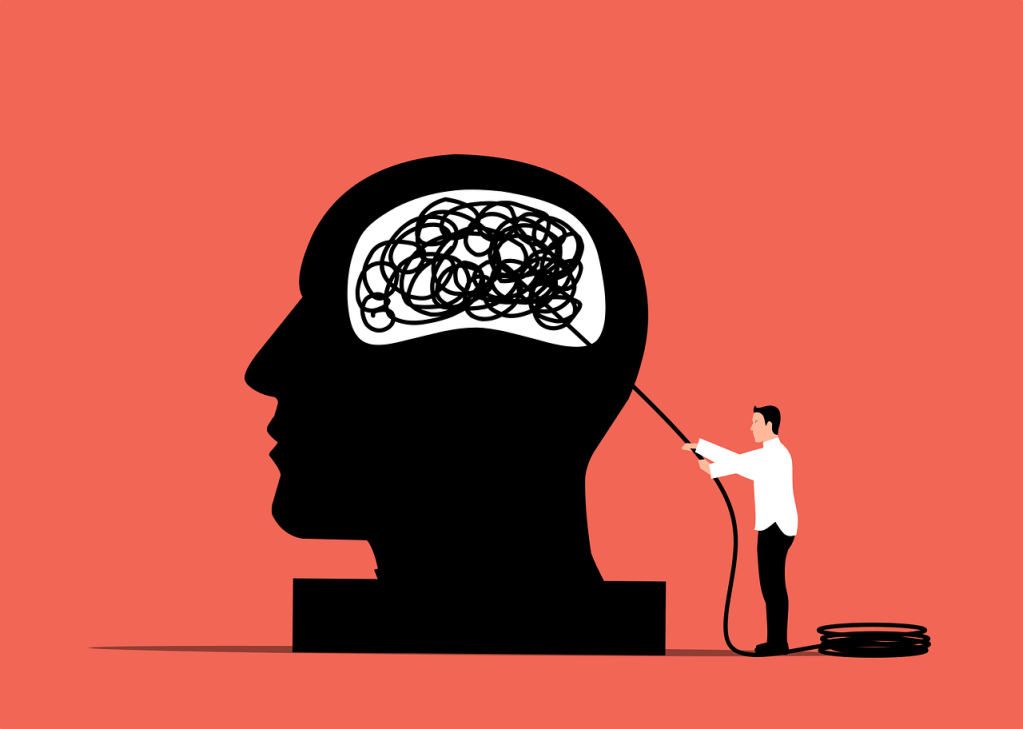
The mind is divided into the conscious and the unconscious. If we do not like to use these two words, we might use the terms, superficial and hidden, the superficial parts of the mind and the deeper layers of the mind. The whole of the conscious as well as the unconscious, the superficial as well as the hidden, the total process of our thinking- only part of which we are conscious of, and the rest, which is the major part, we are not conscious of —is what we call consciousness. This consciousness is time, the result of centuries of man’s endeavor.
We are made to believe in certain ideas from childhood, we are conditioned by dogmas, by beliefs, by theories. Each one of us is conditioned by various influences, and from that conditioning, from those limited and unconscious influences, our thoughts spring and take the form of a Communist, a Hindu, a Muslim, or a scientist. Thought obviously springs from the background of memory, of tradition, and it is with this background of both the conscious as well as the unconscious, the superficial as well as the deeper layers of the mind, that we meet life. Life is always in movement, never static.
But, our minds are static. Our minds are conditioned, held, tethered to dogma, to belief, to experience, to knowledge.
With this tethered mind, with this mind that is so conditioned, so heavily held, we meet life, which is in constant movement.
A total, an enriching revolution cannot take place unless you and I understand ourselves as a total process. You and I are not isolated individuals but are the result of the whole human struggle with its illusions, fancies, pursuits, ignorance, strife, conflict, and misery. One cannot begin to alter the condition of the world without understanding oneself. If you see that, there is immediately within you a complete revolution, is there not? Then no guru is necessary because knowledge of oneself is from moment to moment, it is not the accumulation of hearsay, nor is it contained in the precepts of religious teachers. Because you are discovering yourself in relationship with another from moment to moment, relationship has a completely different meaning. Relationship then is a revelation, a constant process of the discovery of oneself, and from this self-discovery, action takes place.
We do not really enjoy anything. We look at it, we are superficially amused or excited by it, we have a sensation which we call joy. But enjoyment is something far deeper, which must be understood and gone into.
When we are young, we enjoy and take delight in things—in games, in clothes, in reading a book or writing a poem or painting a picture, or in pushing each other about…As we grow older, although we still want to enjoy things, the best has gone out of us; we prefer other kinds of sensations— passion, lust, power, position.
When the mind goes beyond the thought of the ‘me’, the experiencer, the observer, the thinker, then there is a possibility of happiness which is incorruptible. That happiness cannot be made permanent, in the sense in which we use that word. But, our mind is seeking permanent happiness, something that will last, that will continue. That very desire for continuity is corruption. But when the mind is free from the ‘me’, there is a happiness, from moment to moment, which comes without your seeking, in which there is no gathering, no storing up, no putting by of happiness. It is not something which you can hold on to.
Man has lived for two million years or more, but he has not solved the problem of sorrow. He is always sorrow-ridden: he has sorrow as his shadow or as his companion. Sorrow of losing somebody; sorrow in not being able to fulfill his ambitions, his greed, his energy; sorrow of physical pain; sorrow of psychological anxiety; sorrow of guilt; sorrow of hope and despair—that has been the lot of man; that has been the lot of every human being.
There is a vast distinction between intellect and intelligence. Intellect is merely thought functioning independently of emotion. When intellect, irrespective of emotion, is trained in any particular direction, one may have great intellect, but one does not have intelligence, because in intelligence there is the inherent capacity to feel as well as to reason; in intelligence both capacities are equally present, intensely and harmoniously.
Source : What Are You Doing With Your Life? by J. Krishnamurti
Goodreads : https://www.goodreads.com/book/show/22145861-what-are-you-doing-with-your-life
Read Next Article : https://thinkingbeyondscience.in/2025/05/01/the-purpose-of-life-beyond-conditioning-and-loneliness/








 Thinking Beyond Science
Leave a reply to The Purpose of Life: Beyond Conditioning and Loneliness – Thinking Beyond Science Cancel reply