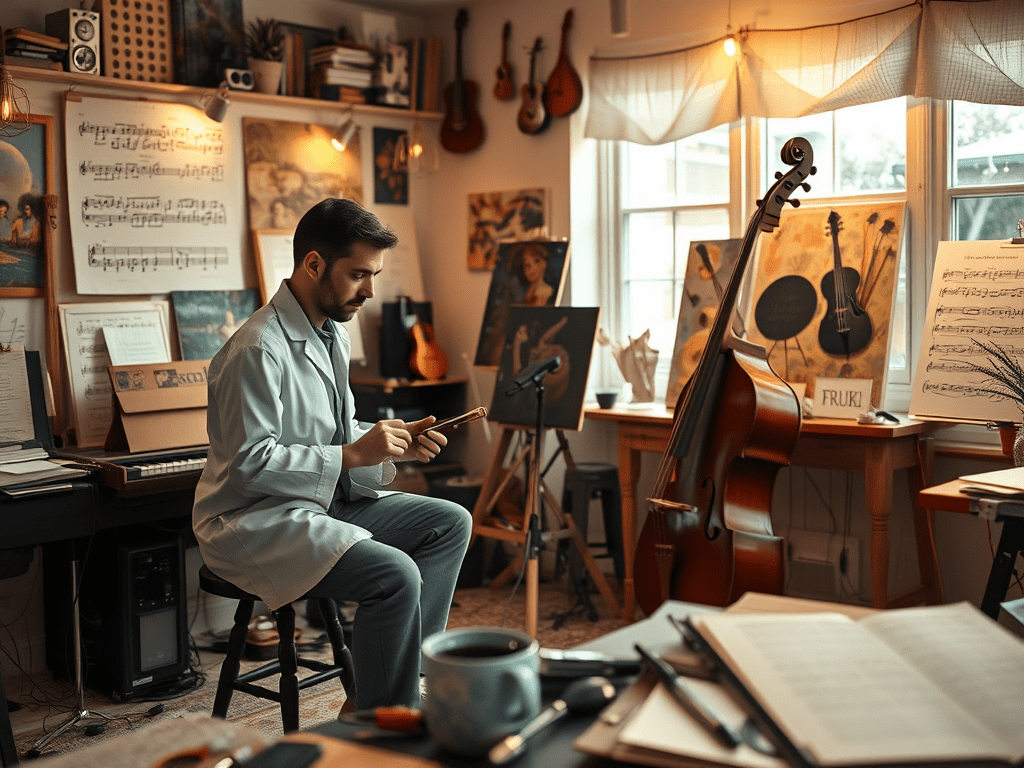
William Forde Thompson (a music cognition scientist and composer at the University of Toronto) adds that the work of both scientists and artists involves similar stages of development: a creative and exploratory “brainstorming” stage, followed by testing and refining stages that typically involve the application of set procedures, but are often informed by additional creative problem-solving. Artists’ studios and scientists’ laboratories share similarities as well, with a large number of projects going at once, in various stages of incompletion. Both require specialized tools, and the results are unlike the final plans for a suspension bridge, or the tallying of money in a bank account at the end of the business day—open to interpretation.
What artists and scientists have in common is the ability to live in an open-ended state of interpretation and reinterpretation of the products of our work. The work of artists and scientists is ultimately the pursuit of truth, but members of both camps understand that truth in its very nature is contextual and changeable, dependent on point of view, and that today’s truths become tomorrow’s disproven hypotheses or forgotten objects d’art. One need look no further than Piaget, Freud, and Skinner to find theories that once held widespread currency and were later overturned (or at least dramatically reevaluated).
In music, a number of groups were prematurely held up as of lasting importance: Cheap Trick were hailed as the new Beatles, and at one time the Rolling Stone Encyclopedia of Rock devoted as much space to Adam and the Ants as they did to U2. There were times when people couldn’t imagine a day when most of the world would not know the names Paul Stookey, Christopher Cross, or Mary Ford. For the artist, the goal of the painting or musical composition is not to convey literal truth, but an aspect of a universal truth that if successful, will continue to move and to touch people even as contexts, societies, and cultures change. For the scientist, the goal of a theory is to convey “truth for now” —to replace an old truth, while accepting that someday this theory, too, will be replaced by a new “truth,” because that is the way science advances.
Music is unusual among all human activities for both its ubiquity and its antiquity. No known human culture now or anytime in the recorded past lacked music. Some of the oldest physical artifacts found in human and protohuman excavation sites are musical instruments: bone flutes and animal skins stretched over tree stumps to make drums. Whenever humans come together for any reason, music is there: weddings, funerals, graduation from college, men marching off to war, stadium sporting events, a night on the town, prayer, a romantic dinner, mothers rocking their infants to sleep, and college students studying with music as a background. Even more so in nonindustrialized cultures than in modern Western societies, music is and was part of the fabric of everyday life.
Only relatively recently in our own culture, five hundred years or so ago, did a distinction arise that cut society in two, forming separate classes of music performers and music listeners. Throughout most of the world and for most of human history, music making was as natural an activity as breathing and walking, and everyone participated. Concert halls, dedicated to the performance of music, arose only in the last several centuries.
A couple of generations ago, before television, many families would sit around and play music together for entertainment. Nowadays there is a great emphasis on technique and skill, and whether a musician is “good enough” to play for others. Music making has become a somewhat reserved activity in our culture, and the rest of us listen. The music industry is one of the largest in the United States, employing hundreds of thousands of people. Album sales alone bring in $30 billion a year, and this figure doesn’t even account for concert ticket sales, the thousands of bands playing Friday nights at saloons all over North America, or the thirty billion songs that were downloaded free through peer-to-peer file sharing in 2005.
Americans spend more money on music than on sex or prescription drugs. Given this voracious consumption, I would say that most Americans qualify as expert music listeners. We have the cognitive capacity to detect wrong notes, to find music we enjoy, to remember hundreds of melodies, and to tap our feet in time with the music—an activity that involves a process of meter extraction so complicated that most computers cannot do it. Why do we listen to music, and why are we willing to spend so much money on music listening? Two concert tickets can easily cost as much as a week’s food allowance for a family of four, and one CD costs about the same as a work shirt, eight loaves of bread, or basic phone service for a month. Understanding why we like music and what draws us to it is a window on the essence of human nature.
To ask questions about a basic, and omnipresent human ability is to implicitly ask questions about evolution. Animals evolved certain physical forms as a response to their environment, and the characteristics that conferred an advantage for mating were passed down to the next generation through the genes.
A subtle point in Darwinian theory is that living organisms-whether plants, viruses, insects, or animals coevolved with the physical world. In other words, while all living things are changing in response to the world, the world is also changing in response to them. If one species develops a mechanism to keep away a particular predator, that predator’s species is then under evolutionary pressure either to develop a means to overcome that defense or to find another food source. Natural selection is an arms race of physical morphologies changing to catch up with one another.
The power of music to evoke emotions is harnessed by advertising executives, filmmakers, military commanders, and mothers. Advertisers use music to make a soft drink, beer, running shoe, or car seem more hip than their competitors’. Film directors use music to tell us how to feel about scenes that otherwise might be ambiguous, or to augment our feelings at particularly dramatic moments. Think of a typical chase scene in an action film, or the music that might accompany a lone woman climbing a staircase in a dark old mansion: Music is being used to manipulate our emotions, and we tend to accept, if not outright enjoy, the power of music to make us experience these different feelings. Mothers throughout the world, and as far back in time as we can imagine, have used soft singing to soothe their babies to sleep, or to distract them from something that has made them cry.
The mind has been opened up in the last few years by the exploding field of neuroscience and the new approaches in psychology due to new brain-imaging technologies, drugs able to manipulate neurotransmitters such as dopamine and serotonin, and plain old scientific pursuit. Less well known are the extraordinary advances we have been able to make in modeling how our neurons network, thanks to the continuing revolution in computer technology. We are coming to understand computational systems in our head like never before. Language now seems to be substantially hardwired into our brains. Even consciousness itself is no longer hopelessly shrouded in a mystical fog, but is rather something that emerges from observable physical systems. But no one until now has taken all this new work together and used it to elucidate what is for me the most beautiful human obsession. Your brain on music is a way to understand the deepest mysteries of human nature.
Source : This Is Your Brain on Music by Daniel J. Levitin
Goodreads : https://www.goodreads.com/book/show/141565.This_Is_Your_Brain_on_Music
Read Next Article : https://thinkingbeyondscience.in/2025/05/29/exploring-melody-timbre-and-musical-emotion/








 Thinking Beyond Science
Leave a comment