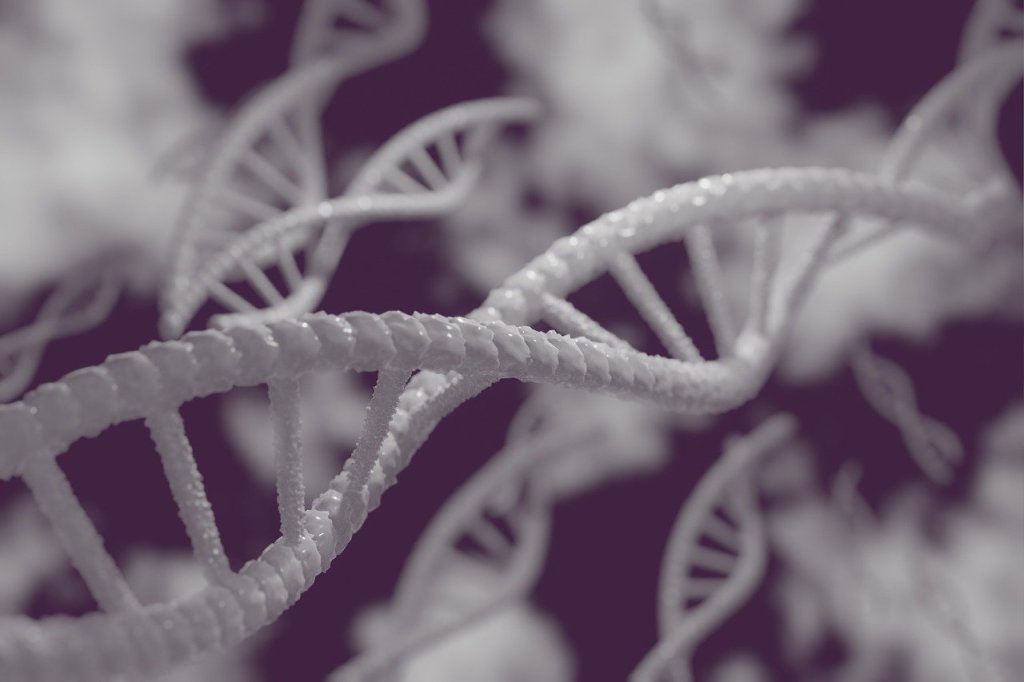
How gene editing works. One of those two components is called the guide molecule. It’s made from a molecule called RNA, which is related to DNA. Like DNA, it is composed of four letters. Unlike DNA, it’s single-stranded whereas DNA is double-stranded. Where DNA forms the iconic double helix, composed of two strands of DNA letters binding to each other, RNA is a singleton. There’s only one strand and this is an important factor in its activity in gene editing.
Most of the time this will be impossible, but if the guide finds a region where its own sequence of letters is the same as that in the DNA, the guide molecule pushes its way into the double helix. It’s easy to use our knowledge of the genome to create a guide molecule that will bind to only one DNA sequence, for example a mutation that leads to a disease.
The guide molecule is now in position where we want it, and the targeting phase of gene editing is complete. This relies on the second component which is a protein that can act like a pair of molecular scissors, cutting across the DNA double helix. These scissors don’t cut randomly; they don’t just flail across the genome. Instead, they only cut where the guide molecule has inserted itself into the DNA. This is because the guide molecule also contains a sequence that the scissors recognise. Only after the scissors have bound to the interloping guide molecule do they snip across the DNA.
This cut damages the DNA, but all cells contain mechanisms to repair DNA very quickly. In fact, the repair mechanisms often prioritize speed over accuracy and the repair is a bit of a botch job. The two loose ends of DNA get joined together but the join isn’t quite the same as the original sequence of letters. The end-result of this is usually that the gene is no longer functional.
Using the first version of gene editing, extra letters would be inserted into the inappropriate word, or deleted from it. ‘Inferior’ might be altered to ‘inferential’ or ‘inior’. Both of these are clearly nonsense and would at least stop the person reading the card from assuming that you are rubbish at furniture selection and room layouts. This might seem of limited use in printing, but in genetics it’s a fantastic way to stop a gene from working. This can be remarkably useful. It allows scientists to test hypotheses about what a specific gene does in a cell or organism, and could even be useful therapeutically if a mutated gene codes for a dangerous protein.
Of course, you have to be able to get the guide RNA and the cutting protein into the cells you want to change but this isn’t especially difficult, at least in a lab. This is often achieved by co-opting a simple virus that is very good at entering cells but doesn’t actually cause any harm to the host. Scientists package the two components required for gene editing into the virus and then infect the target cells. Once inside the cells, the virus releases its payload and the gene editing process begins.
In cells that don’t divide, such as neurons or heart muscle cells, the alteration to the genome will survive for as long as the cell does. In cells that do divide, the alteration will be passed on to all subsequent generations of the cells. It’s a one-hit wonder that lasts forever.
Source – Hacking the Code of Life: How gene editing will rewrite our futures by Nessa Carey
Goodreads – https://www.goodreads.com/book/show/43359681-hacking-the-code-of-life
Read Previous Article : https://thinkingbeyondscience.in/2024/11/19/how-early-farming-and-genetic-manipulation-shaped-human-civilization/
Read Next Article : https://thinkingbeyondscience.in/2025/06/04/the-challenges-of-food-production-in-a-growing-population/








 Thinking Beyond Science
Leave a reply to The Challenges of Food Production in a Growing Population – Thinking Beyond Science Cancel reply