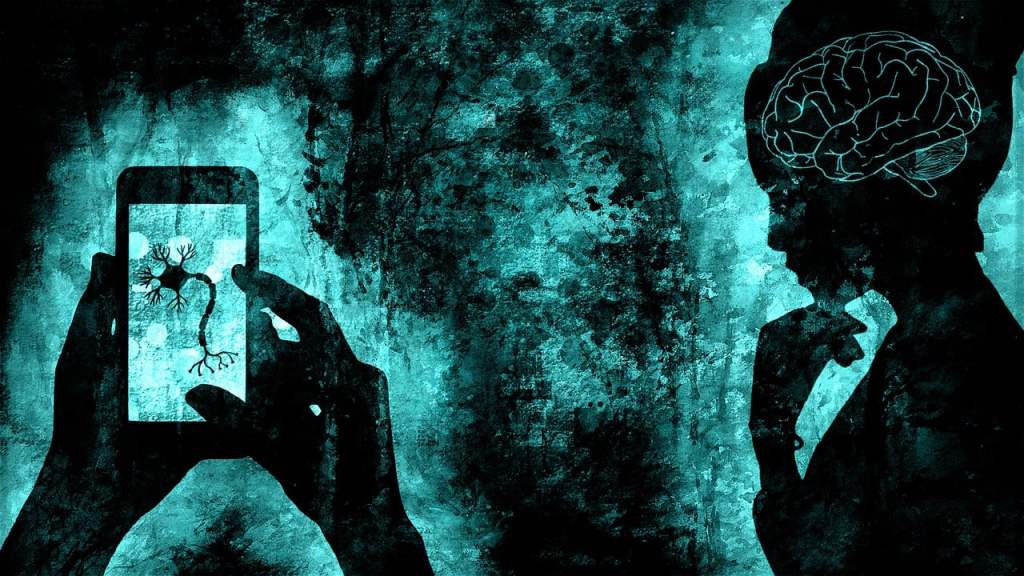
We all know the power of visual illusions to trick the mind into perceiving things incorrectly, but the most powerful illusion is the sense that we exist inside our heads as an integrated, coherent individual or self. As a self, we feel that we occupy our bodies. On an intellectual level, most of us understand that we need our brains, but few of us think that everything that makes us who we are can be reduced down to a lump of tissue. Most of us think that we are not simply our brain. In fact, we are our brains, but the brain itself is surprisingly dependent on the world it processes and, when it comes to generating the self, the role of others is paramount in shaping us.
There are many different types of cells but for our purposes, the nerve cell or ‘neuron’ is the basic building block of the circuit of the brain that do all the really clever stuff. There are an estimated eighty. six to one hundred billion of these neurons – the elements of the microcircuitry that create all of our mental life. There are three major types of neurons. Sensory neurons respond to information picked from the environment through our senses. Motor neurons relay information that controls our movement outputs. But it is the third class of neuron that makes up the majority – the interneurons, which connect the input and the output of the brain into an internal network where all the really clever stuff happens. It is this internal network that stores information and performs all the operations that we recognize as higher thought processes.
By themselves, neurons are not particularly clever. When not active, they idle along occasionally discharging an electrical impulse like a Geiger counter that picks up background radiation. When they receive a combined jolt of incoming activity from other neurons, they burst into activity like a machine-gun, sending cascading impulses out to others.
One way to consider how the brain is organized structurally and functionally is to consider it like an onion. At the core of the onion is the brain stem that regulates the basic body functions that keep us alive, such as breathing and blood circulation. Above the brain stem is the midbrain region that controls activity levels such as wakefulness and appetite. The midbrain also governs basic motor control and sensory processing. Arising out of the midbrain is the limbic system, a network that controls emotions and drives such as aggression and sex. This has been called the ‘reptilian brain’ because it controls the sorts of functions we share with lizards and snakes.’ These functions are simply triggered by the sight of a competitor or a potential mate – like a knee-jerk reaction. Deep in the history of our species, we behaved in this automatic way but eventually we evolved higher levels of brain machinery that enabled us to control these reptilian urges.
Sitting on top of everything is the cortex, a thin layer on the surface of the brain packed with neurons that support higher-order processing for interpreting the world, generating knowledge and planning actions.
It is quite clear that we are born with many basic neural patterns in place. Many sensory and motor areas are well specified at birth even though they have yet to reach their full adult potential. But babies are not just passive sponges soaking up sensation from their environment – they can also act upon the world. For example, each human newborn is equipped with a repertoire of behaviours known as reflexes that play some vital role in development. Consider the rooting reflex, triggered by gently stroking the cheek of a newborn, which makes the baby turn their head and pucker up their lips in anticipation of a tasty nipple. If a nipple (or at least something of a similar shape) is touched to the baby’s lips, this then triggers a sucking reflex. You might think that the baby has decided to feed, but the truth is that these behaviours are completely involuntary and automatic and do not require any thinking. In fact, you do not need a very sophisticated brain to execute them. Anencephalic babies, born without any cortex, can still execute sucking reflexes because these behaviours are supported by primitive neural circuitry that lies beneath the cortex. But anencephalic babies are never destined to experience what it is to be human. They do not learn. They do not get bored.
Our brains have evolved to be malleable through experience but some experiences are required and expected at certain times during our lifetime. As noted above, deprivation can lead to permanent problems in later life but it turns out that these effects are most pronounced at certain times. Once the connections have been pruned due to inactivity, it is increasingly difficult to re-establish communication between the relevant parts of the brain. The window of opportunity has slammed shut.
These episodes of time-limited brain development are sometimes called critical periods’ because no amount of remedial exposure after the window of opportunity has passed can reinstate the lost function. In truth, ‘sensitive period is probably more accurate as the brain has a remarkable capacity to recover, although it is worth noting that sensitive periods apply only to some of our human abilities and not others. Natural selection has evolved brains to expect certain experiences at certain times in development.
The reason is quite simple: like any successful manufacturer, nature always seems optimized to cut the cost of production. Nature prefers to build machines that are tailored to work without being over-specialized. For example, there is no point building an all-purpose machine when some purposes are unlikely or redundant – that would be too costly. It is much better and more efficient to anticipate the most likely world rather than having the machine specified in advance. This is how evolution selects for the best fit. Those with systems that are not optimized for their environment are not as efficient and will eventually lose the race to reproduce. This explains why babies’ brains are pre-wired loosely to expect certain worlds they have not yet encountered and then become streamlined and matched to their own world through experience.
For example, birds of species that flock together have comparatively larger brains than those that are more isolated. A change in brain size can even occur within the lifespan of an individual animal such as the locust. Locusts are normally solitary and avoid each other but become ‘gregarious’ when they enter the swarm phase of their life cycle.
This swarm phase of the locust is triggered by the build up of locusts as their numbers multiply, threatening food supply, which is why they swarm to move en masse to a new location. As they rub against each other, this tactile stimulation sets off a trigger in their brain to start paying attention to each other. Amazingly, areas associated with learning and memory quickly enlarge by one third as they begin to swarm and become more tuned in to other locusts around them to become a devastating collective mass.?
Larger brains facilitate social behaviour. The link between brain size and sociability is especially true for primates where the extent of the cortex predicts the social group size for the species even when you take body mass into consideration. For example, gorillas may be big primates but they are fairly solitary animals with small close-knit family units and so their cortex is comparatively smaller than that of chimpanzees, which are much more sociable and like to party.
Source : The Self Illusion: Why There is No ‘You’ Inside Your Head by Bruce M. Hood
Goodreads : https://www.goodreads.com/book/show/13384559-the-self-illusion
Read Previous Article : https://thinkingbeyondscience.in/2025/01/11/the-brains-role-in-shaping-our-identity/
Read the Next Article in Series :








 Thinking Beyond Science
Leave a reply to The Brain’s Role in Shaping Our Identity – Thinking Beyond Science Cancel reply