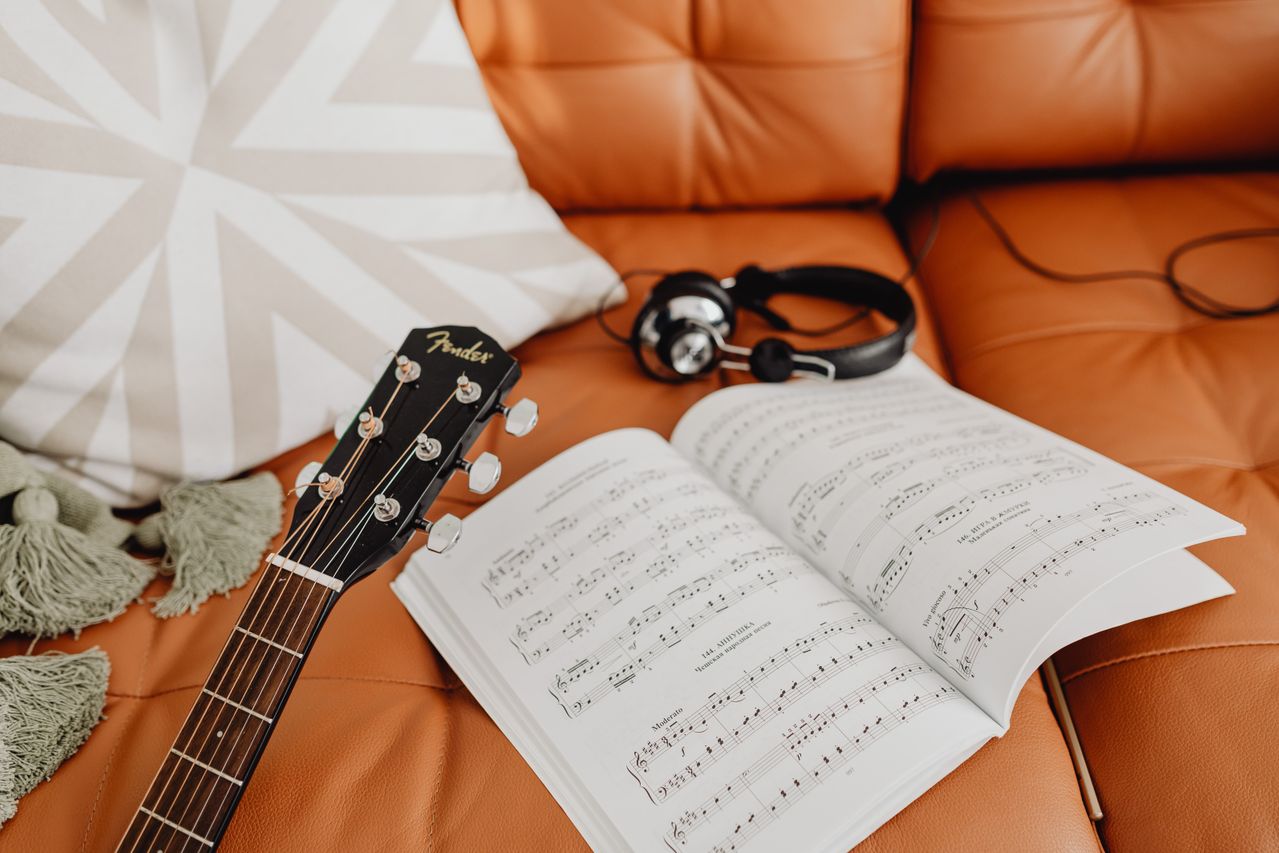
Music is everywhere — in your earphones, in cafés, in every film scene. It feels like it has always been this way. It hasn’t.
Until recorded music became affordable and widespread, most people heard music only at fairs, concerts, and social gatherings. The saturated musical environment we take for granted is, in historical terms, brand new. Yet music’s relationship with the human brain is ancient, intricate, and far deeper than most people realize.
Music Is Time, Organized
Music is patterns in time. Our auditory system is exquisitely sensitive to these patterns — far more sensitive to timing than our visual system. This is why timing is not incidental to music; it is foundational. Strike the same notes in a different rhythm, and you have an entirely different emotional experience.
Brain-imaging studies show that listening to music activates three major systems simultaneously:
- The auditory system processes melody
- The motor system reflects timing
- The limbic system responds to emotional nuances
Music does not activate one region. It lights up the whole brain — which is widely considered the reason it has such a broad positive effect on us.
Both Hemispheres Are Listening
The popular idea that music is purely a “right brain” activity is a myth. The right hemisphere is more involved in processing pitch; the left handles timing. Both are active when you listen to music, simply focused on different aspects of the same experience.
Notes, Scales, and Why Some Sounds Feel Wrong
Across all cultures, music is built from discrete pitch levels — notes — clearly separated from one another. The frequencies in between feel “off.” This is not because we cannot hear them; speech perception relies on subtle pitch shifts that fall outside musical scales. But in a musical context, those in-between sounds simply do not fit. That feeling comes from a mix of acoustic physics and a lifetime of cultural listening.
Which combinations of notes feel natural — that sense that one note wants to follow another — is shaped by both the properties of sound and the listener’s cultural background.
The Body Cannot Help But Move
Even people who consider themselves tone-deaf respond to musical rhythm. Foot-tapping, head-nodding, clapping — these happen automatically, because the auditory and motor systems of the brain are deeply connected.
The proof: we do not respond the same way to visual rhythm. A bouncing ball timed to the same beat does not make you tap your foot. It is specifically sound that triggers movement.
This link is universal. Every human culture on Earth, without exception, has some tradition of music and dance. Dance connects auditory input with muscular action and with the vestibular system — the inner ear’s sense of balance. When you move to music, your brain is integrating sound, movement, and spatial orientation all at once.
What Playing an Instrument Does to the Brain
Listening to music is demanding. Playing it is something else entirely.
A pianist must connect a spatial decision — which key to press — with an auditory target, rapidly and automatically, thousands of times per session. To do this, the brain forges automatic connections between the motor cortex, the cerebellum, the auditory cortex, and the frontal cortex.
Years of this practice physically reshape the brain. Professional musicians show larger motor cortex regions, more symmetrical auditory areas, and a more developed corpus callosum — the band of fibres connecting the two hemispheres.
For most people, listening to music primarily involves the right hemisphere. For trained musicians, both hemispheres are active, with the left often more active than the right — because musicians bring formal analytical knowledge to their listening, the way a fluent reader reads text rather than sounding out letters.
Why This Matters
Music is one of the most neurologically complex activities a human being can engage in. It engages both hemispheres, connects movement to sound, organizes emotion, and physically reshapes the brain through practice. It crosses every cultural boundary ever drawn.
The fact that it surrounds us constantly is new. Our capacity to be transformed by it is as old as we are.
Source : Your Brain and You: A Simple Guide to Neuropsychology by Nicky Hayes
Goodreads : https://www.goodreads.com/book/show/39088936-your-brain-and-you
Get it on Amazon Com : https://amzn.to/457vcnT
Get it on Amazon IN : https://link.amazon/B0f3NcPf3
Read the Previous Post in the Series :







Leave a Reply