There is a paradox at the heart of modern biodiversity. Visit almost any location on Earth — a park, a coastline, an island — and you will likely find more species there than existed a few hundred years ago. In this narrow sense, humans have been remarkably generous. We have introduced species to places they never reached on their own, filling ecological gaps and expanding the range of life across the planet.
And yet, globally, the total number of distinct species on Earth has fallen. Local diversity up. Global diversity down. Both things are true simultaneously, and understanding why reveals something uncomfortable about what we have done — and what we continue to do.
The Travelling Advantage
When a species is introduced to a new environment, it often arrives without the predators, parasites, and competitors that kept it in check back home. It has, in effect, shed its evolutionary history. Biologists call this “enemy release” — and for invasive species, it can be explosive. Freed from the constraints that shaped them over millennia, introduced species sometimes proliferate beyond anything their native range would have permitted.
Hawaii is a useful case study. Before human arrival, the islands had no rodents, no amphibians, no terrestrial reptiles, no ungulates, no ants, no aphids, no mosquitoes. People introduced all of these. In raw numerical terms, Hawaii gained species.
But Hawaii was also home to thousands of species found nowhere else on Earth. Hundreds of endemic land snails. Dozens of unique bird species. Over a hundred species of ferns and flowering plants found on those islands and nowhere else. Many are now gone. Others are disappearing. The arrivals filled the islands; the originals were erased. What looks like enrichment at the local level is, at the global level, an irreversible narrowing.
The Slow Disappearance of the Rhinoceros
Few stories illustrate this narrowing more starkly than the decline of the world’s rhinoceroses.
The Sumatran rhino once ranged across a vast arc of southeast Asia — from the Himalayan foothills through Myanmar, Thailand, Cambodia, the Malay Peninsula, and onto the islands of Sumatra and Borneo. In the nineteenth century it was common enough to be considered an agricultural pest. As forests were cleared and habitat fragmented, its population collapsed. By the early 1980s, only a few hundred remained.
The Javan rhino, once spread across most of southeast Asia, now numbers fewer than fifty individuals — all confined to a single reserve in Java. The last known Javan rhino outside that reserve was killed by a poacher in Vietnam in 2010.
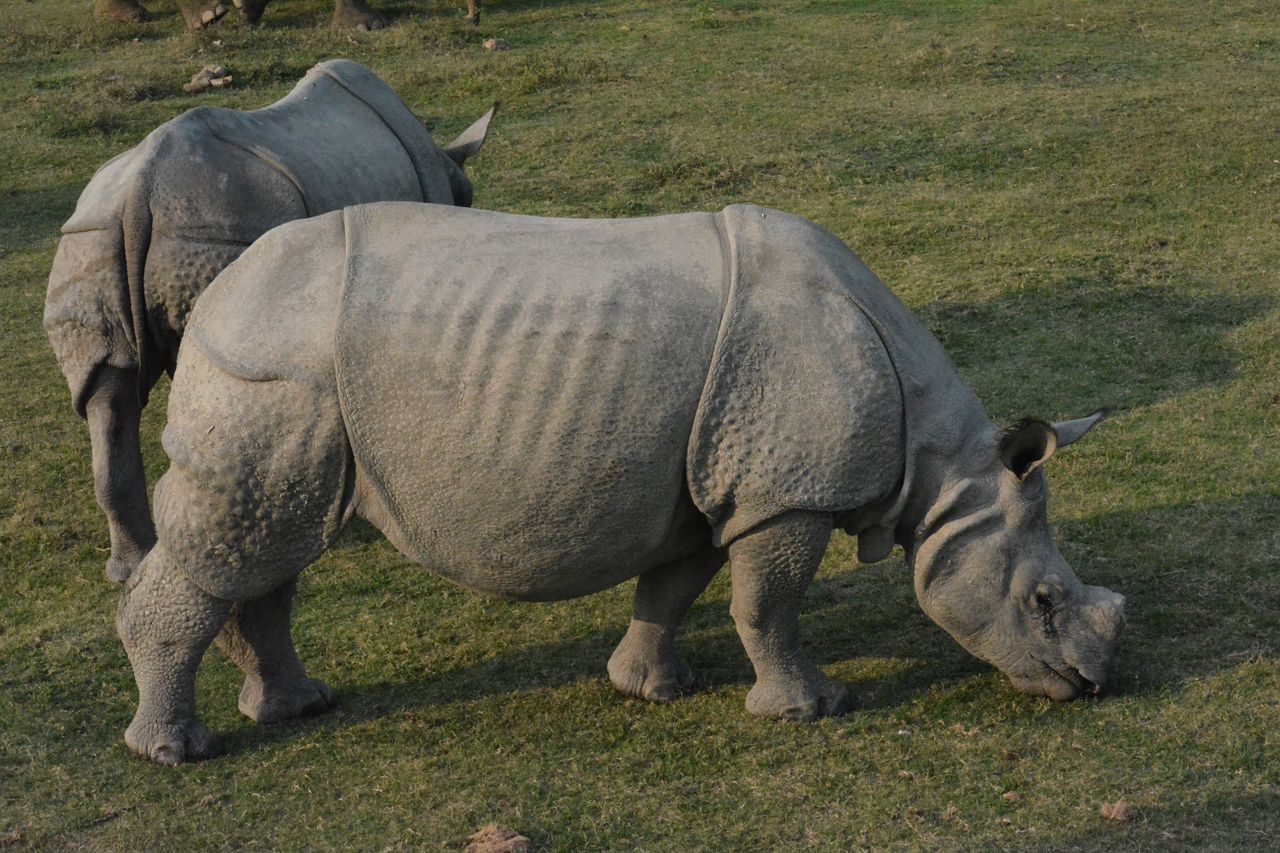
The Indian rhino, the largest of the five species, has been reduced to around three thousand animals, most living in four parks in Assam. A century ago, Africa’s black rhino population approached one million. It now stands at around five thousand.
The white rhino is the only species not currently classified as threatened — but its story is a warning, not a comfort. Hunted nearly to extinction in the nineteenth century, it recovered dramatically through conservation efforts in the twentieth, only to face renewed pressure in the twenty-first from poachers supplying a black market that pays up to fifty thousand US dollars per kilogram of horn. The horn is made of keratin — the same material as your fingernails — but has long been used in traditional Chinese medicine and has more recently become sought after as a status drug, snorted at clubs across southeast Asia.
The rhinos are not an anomaly. They are a pattern.
Extinction Comes in Pulses
The loss of large animals — megafauna — did not happen all at once. It came in waves, each one correlated with the arrival of modern humans in a new region.
The first pulse struck Australia roughly forty thousand years ago, wiping out its giant fauna. A second pulse hit North and South America around fifteen thousand years ago, when humans crossed from Siberia. Madagascar’s giant lemurs, pygmy hippos, and elephant birds survived into the Middle Ages. New Zealand’s moas endured until the Renaissance. In each case, the pattern is the same: humans arrive, and shortly afterward, the large animals vanish.
The debate over cause — active hunting, habitat disruption, or something more indirect — continues. But the correlation is difficult to dismiss.
The Neanderthal Question
The most uncomfortable chapter in this story involves not another species, but our closest relatives.
Neanderthals lived in Europe for over a hundred thousand years. They survived intense cold, built shelters, and fashioned clothing. For most of their existence, they had no greater impact on their environment than any other large vertebrate. The land they inhabited — with its wild horses and woolly rhinos — remained essentially intact.
Modern humans arrived in Europe around forty thousand years ago. Consistently, the archaeological record shows the same sequence: humans appear in a region, and the Neanderthals in that region disappear. Whether they were actively hunted or simply outcompeted for resources is not known with certainty. Either way, the Neanderthals were gone within roughly ten thousand years of our arrival.
There is one twist. Before modern humans finally displaced the Neanderthals entirely, they had sex with them. The genetic traces of that encounter persist. Most people alive today carry up to four percent Neanderthal DNA.
We absorbed them even as we erased them.
The Difference a Few Genes Make
What separates modern humans from Neanderthals is, genetically, a very small set of variations. But those variations included something with no precedent in the history of life on Earth: the capacity to represent the world in signs and symbols.
Language. Abstract thought. The ability to plan across time, coordinate in large groups, and transmit accumulated knowledge across generations. These capabilities allowed humans to modify their environment at a scale no species had ever managed.
The Neanderthals had no such capacity. They occupied their corner of Europe for a hundred thousand years and left it largely as they found it. There is every reason to believe that, had modern humans not arrived, Neanderthals would still be there today — along with the woolly rhinos and the wild horses.
We arrived, and within a geological instant, they were gone. Along with the megafauna. Along with thousands of endemic species on islands across the world. Along with the Sumatran rhino’s vast range and the Javan rhino’s entire mainland presence.
The capacity to represent the world in symbols is also, it turns out, the capacity to change it. And changing it, at the speed and scale we have managed, is very close to destroying it.
A tiny set of genetic variations separates us from the Neanderthals. But that has made all the difference.
Source : The Sixth Extinction: An Unnatural History by Elizabeth Kolbert
Goodreads : https://www.goodreads.com/book/show/17910054-the-sixth-extinction
Buy on Amazon Com : https://amzn.to/3T7BUaV
Buy on Amazon IN : https://link.amazon/B00rVlBxv
Read the Previous Article in the Series :




Leave a Reply