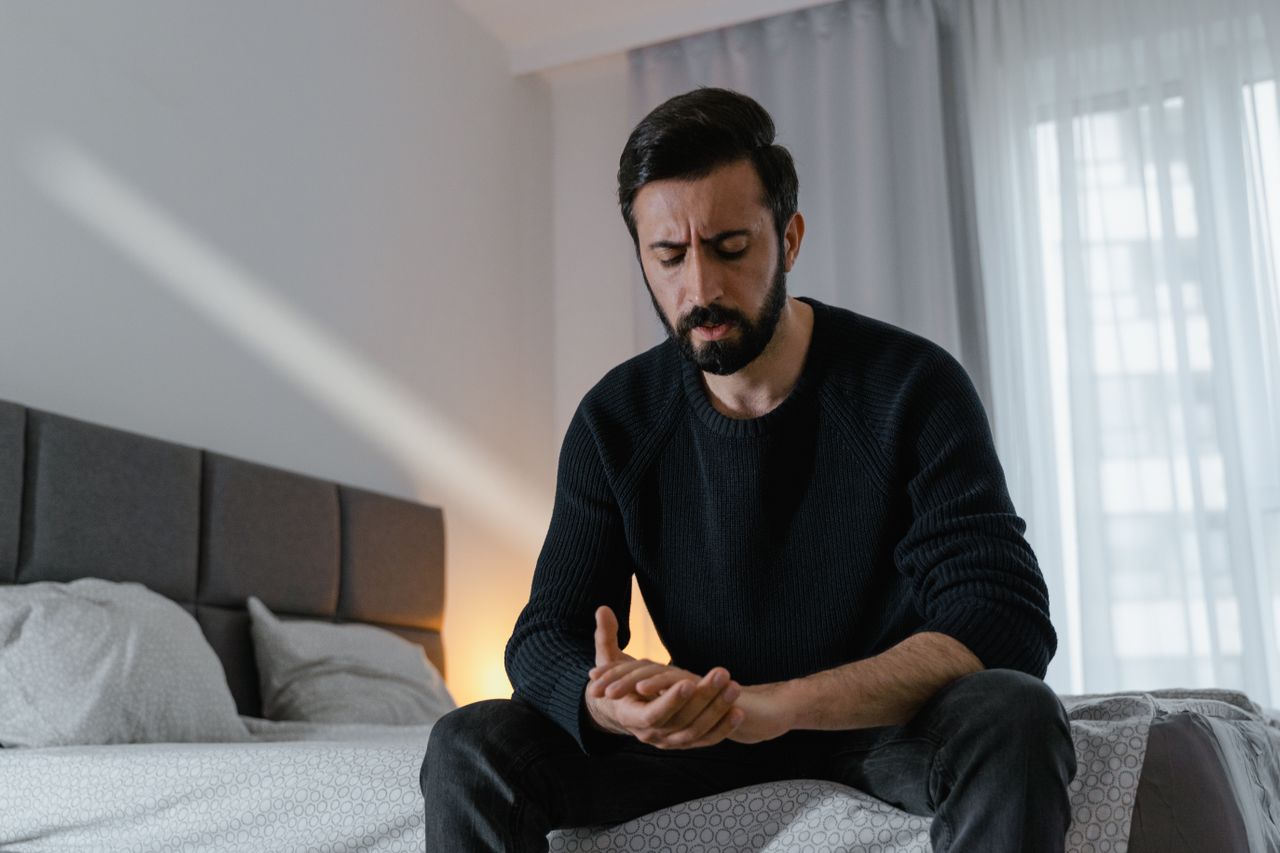
We tend to think of the human body as a fixed thing — bounded by skin, owned by a self, defined by its edges. But the science emerging from labs, operating theatres, and microbiology departments tells a stranger story: the borders of the self are negotiable, the body is a canvas, and the line between “me” and “not-me” is more arbitrary than we ever imagined.
The Uncanny Valley of the Transplanted Arm
When surgeons successfully transplant a limb from a dying donor to a living recipient, the outcome is — medically speaking — often a success. The hand is accepted. Blood flows. Fingers move. And yet something deeper frequently fails.
The sensory return is crude at best: hot versus cold, smooth versus sharp. Fine motor control remains limited. Recipients face lifelong medication and the prospect of chronic complications. But the most profound disappointment tends to be psychological. It is deeply difficult to take mental ownership of an arm that neither moves nor looks like your own — and harder still when that arm belonged to a stranger, one who was on the brink of death.
The experiences of recipients capture this starkly. The very first hand transplant attempt, in 1966, was physically successful but psychologically unbearable. The recipient found the alien hand so repugnant that he eventually demanded it be removed. In a later double-hand transplant case, the recipient took months to stop referring to one of the hands as “it.”
Not everyone has struggled. Matthew Scott, fourteen years after receiving a new arm, held a press conference to emotionally thank his surgical team — calling the procedure a “wonderful success” that changed his life. But his experience appears to be the exception rather than the rule.
The question these cases raise is not merely medical. It is philosophical. Why is it so difficult to claim a functional, flesh-and-blood arm as your own? The answer lies in something called proprioception — the brain’s internal map of the body, its ongoing reckoning with what belongs to the self and what does not.
Redesigning the Body from the Ground Up
Hugh Herr lost both legs to frostbite at seventeen, following a mountaineering accident. He responded not with resignation but with engineering. As director of the biomechatronics research group at the MIT Media Lab, he now keeps eight or more types of bionic legs in his closet — one for running, several for climbing, including a pair with spiked feet for penetrating ice walls and another for balancing on edges the width of a coin. He also owns fins for swimming, which, he cheerfully notes, can turn him into a merman.
Herr thinks of the body not as a fixed biological fact but as a blank canvas — something to be improved upon rather than merely repaired. And his vision extends well beyond his own situation. He foresees a future where clothing itself becomes intelligent: skin-like materials that stiffen to reduce joint stress during a run, or robotic attachments that span a painful knee and absorb the load that biology can no longer handle.
Most provocatively, he reframes prosthetics as a form of asymmetric aging. “My biological body will degrade in time due to normal, age-related degeneration,” he has said. “But the artificial part of my body improves in time because I can upgrade.” By eighty, he predicts, he will walk with less energy expenditure than a person with biological legs, with greater stability, and likely greater speed.
This is a genuinely new way of thinking about the body — not as something we are given and must manage, but as a platform we can iterate on.
Teaching the Brain to Feel What Isn’t There
One of the central limitations of prosthetic devices has always been the absence of sensory feedback. The fingers on a prosthetic hand may move, but the amputee does not feel them move. The limb functions without belonging.
This is where proprioceptive illusions become medically significant. Research led by Birgitta Rosén and her Swedish colleagues has demonstrated that the same perceptual trickery underlying the well-known “rubber hand illusion” can be adapted for amputees. In a striking experiment, two amputees were trained in two hours to mentally control a robotic hand through impulses from their stumps. They were then asked to move the robotic fingers and watch them as they moved. In some trials, the experimenter simultaneously stroked both the stump and the robotic hand with a brush — the classic synchronous-touch setup.
Within three minutes, both subjects began to feel sensation in the robotic hand rather than their stump. The brain, given just enough consistent, synchronised information, had incorporated the artificial limb into its proprioceptive map. “A patient with a normal mind,” the researchers concluded, “can be tricked into experiencing an advanced humanoid robotic hand prosthesis as part of their own body.”
For now, the illusion requires the amputee to be looking at the prosthesis. But the next generation of devices may not need that crutch. Engineers are developing stimulators attached to robotic limbs and receptors attached to stumps that would send signals whenever the device moves — bypassing the visual channel entirely and tricking the brain through touch alone. Hugh Herr’s goal is simple and vivid: that an amputee will one day not only walk across a sandy beach, but actually feel the sand against a prosthetic foot.
The 100 Trillion Strangers Inside You
Here is a different kind of body boundary problem. As Stanford microbiologist Stanley Falkow put it, “The world is covered in a fine patina of faces.” Every flush of a toilet aerosolises its contents; faecal particles settle into house dust, onto surfaces, onto toothbrushes within six feet. We are, quite literally, surrounded.
And yet those microbes are not merely tolerated passengers. They are essential. By the time we are five years old, our digestive systems host an estimated 100 trillion microbial life forms — organisms that secrete chemicals critical to our physiological functioning, influencing digestion, allergies, and metabolism. The most effective treatment for certain chronic digestive conditions, including the antibiotic-resistant pathogen Clostridium difficile (which kills fourteen thousand people annually in the United States alone), is a faecal transplant — the deliberate introduction of another person’s gut microbiome, delivered rectally, nasally, or, now, in capsule form.
But the implications extend further than digestion. A growing body of research suggests that gut bacteria directly shape how we think and feel. The microbes in our intestines — species like Bifidobacterium and Lactobacillus rhamnosus — manufacture the same neurochemicals our brains use to regulate mood: serotonin, dopamine, and GABA. Serotonin is the target of blockbuster antidepressants like Prozac and Zoloft. GABA is the target of anti-anxiety drugs like Valium and Xanax. These are not metaphors. The bacteria in your gut are, quite literally, producing the molecules that determine whether you feel anxious or calm, low or content.
The self that thinks and feels is, in part, a product of 100 trillion organisms that are not you.
The Proprioceptive Map: Tool and Weapon
These threads — transplanted limbs, bionic prosthetics, sensory illusions, gut microbiomes — seem to pull in different directions. But they converge on a single, unsettling insight.
In phantom limb syndrome, the brain insists that a missing part is still present. In body integrity disorder, it insists that a present part does not belong. In hand transplants, recipients may reject a working arm psychologically even as their immune systems accept it biologically. And in faecal transplants, health can hinge on welcoming foreign organisms into the most intimate interior of the body. What unites all of these is the same underlying mechanism: the brain’s proprioceptive map — its ongoing, largely automatic reckoning with what counts as self and what does not.
As philosopher Thomas Metzinger puts it, this map is “both a tool and a weapon.” It evolved to preserve and defend the integrity of the organism, which means it is constantly drawing a line between “me” and “not-me.” The surfaces of our bodies are not merely physical borders. They are the sites of a kind of ongoing magic: the transformation of matter from self into non-self, or back again.
What the science suggests is that this line is far more arbitrary, and far more negotiable, than we instinctively feel. The brain can be persuaded, in minutes, to claim a robotic hand as its own. It can refuse, over years, to accept a biological one. Our sense of bodily ownership is not a fact. It is a construction — and one that engineers, surgeons, and neuroscientists are only beginning to learn how to rebuild.
The body has never been the fixed, bounded thing we imagined. It was always a provisional arrangement. We are only now acquiring the tools to redesign it deliberately — and the science to understand what we are actually redesigning when we do.
Source : Stranger in the Mirror: The Scientific Search for the Self by Robert V. Levine
Goodreads : https://www.goodreads.com/book/show/26597356-stranger-in-the-mirror
Get it on Amazon IN : https://link.amazon/B0b00oynD
Get it on Amazon Com : https://link.amazon/B01I0UxWj
Read the Previous Article in the Series :

Leave a Reply