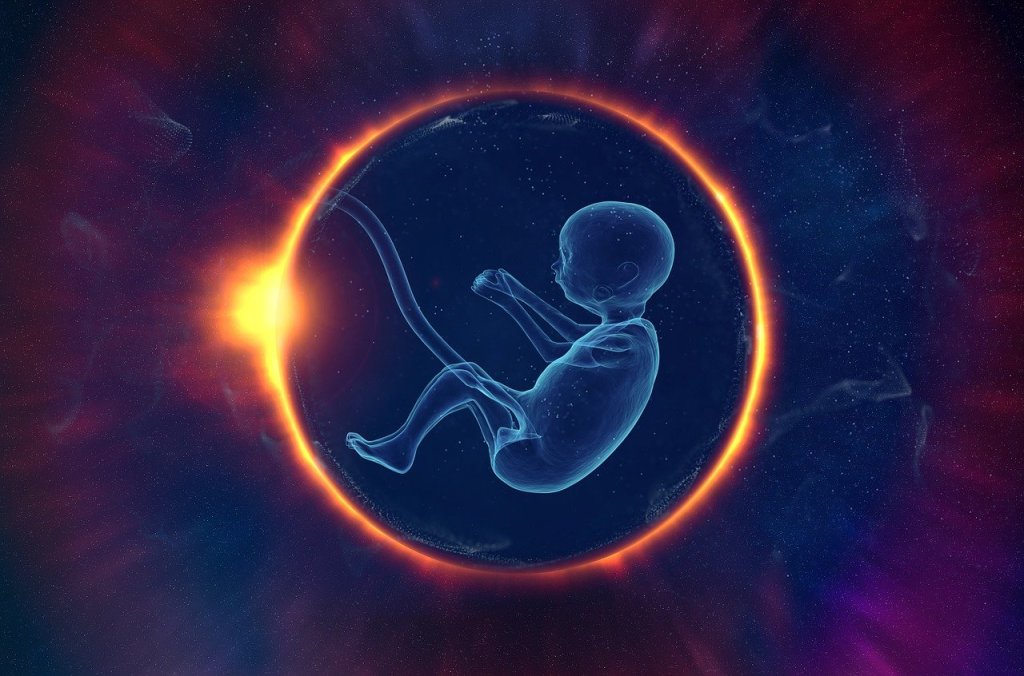
There are various chronological calculations involved, and it’s not unusual for them to get mixed up. Doctors and midwives commonly use the week of pregnancy, which is calculated from the last menstruation. However, conception usually occurs about two weeks after this, so it’s not until a woman begins her third week of pregnancy that she’s actually pregnant. In other words, the fetus is two weeks younger than the week of pregnancy: at the end of the twelfth week of pregnancy, the fetus is ten weeks old; at the end of the fourteenth week it’s twelve weeks old, and so on.
A sperm cell starts out on an intense swimming trip. It looks like a little tadpole, battling wildly upstream against the current and in unknown terrain. It has several hundred million competitors. And it must swim a distance more than one thousand times its own body length. The rules are simple: reach the finishing line first, or die.
The landscape around the sperm is confusing and inhospitable, an overgrown forest full of chaotic thickets and blind alleys. It risks being either swallowed up by immune cells or destroyed by acid on the way. It could also end up trapped in one of the deep crevices in the cervical wall. Before long, such hazards have eliminated most of the field, but our competitor is luckier: the woman’s muscle contractions help to push it upwards and it manages to enter the uterus.
When the woman was a tiny foetus herself she’d already made the forerunners of her egg cells. Later on she began transforming them into mature egg cells. The cell now floating down her fallopian tube was one of the lucky ones. Each month, several egg cells start maturing inside every fertile female, but only one of them gets the chance to escape. The others face certain death.
To create a mature egg cell, the forerunners divide so that the chromosome pairs containing the genes from the new foetus’s grandmother and grandfather are separated. At the end, each mature egg cell has half a set of chromosomes, some from Grandma and others from Grandpa, ready to find itself a new partner. All the while, the egg cell has been packing itself with nutrients, blowing up like a giant compared with the other cells in the body. It’s actually possible to see the egg cell without a microscope: it has a diameter of around a tenth of a millimeter.
Among the many millions of sperm cells, only one of them carries half of your specific genes; the chances of two sperms being identical are vanishingly small. Had another of your father’s sperm swum just a little faster, you would never have existed as you are now.
When your parents’ sperm and egg cells were formed, the chromosomes from your grandparents sat right next to each other; and before the chromosome pairs were separated from each other forever, they managed to exchange small pieces of DNA. So a chromosome that was originally from a grandmother can carry some genes from a grandfather when it ends up in the sperm cell. The possible combinations are endless.
Because its target is slightly warmer than its surroundings, the sperm can tell when it is getting close. In addition, the sperm is equipped with a basic sense of smell. Just as the cells in your nose do, sperm cells contain molecules called odorant recep-tors. Each odorant receptor is programmed to recognise a particular molecule. When air flows into your nose, the fragrance molecules become attached to different odorant receptors and create an electrical signal that is sent to the brain. In the case of sperm cells, the odorant receptors catch molecules streaming from the egg, confirming that it is on the right path.
At the finish line there are relatively few competitors left swimming, and the egg’s attractor chemicals make them travel faster than ever. Soon the egg is completely surrounded by minute tadpoles. Their tails wriggle furiously as they drive forward into the jelly-like membrane protecting their goal. From their heads they spray chemical weapons, enzymes that break down the membrane and allow them to burrow even deeper.
The winner discards its tail, melts into the egg and releases its valuable cargo: twenty-three of the father’s chromosomes. At the same instant, the egg cell releases substances that create a hard capsule around it so that no more sperm can enter. There’s no time to lose: if two sperm cells were to penetrate the egg at the same time, the result would be a cell of sixty-nine chromosomes instead of forty-six.
When that very first cell of yours floats down the fallopian tube, there are forty-six chromosomes sitting safely at its core. Twenty-three of them come from your mother and twenty-three from your father. Each one consists of a long DNA strand, tightly coiled around beads of proteins; which altogether adds up to over two meters of DNA in your one cell. The recipe was fixed when the sperm and the egg cell merged.
IT IS ONE DAY after your conception, and the small hairs in the fallopian tube are nudging the tiny round cell down the canal. Slowly. Carefully. On the outside, everything looks perfectly calm. Deep within the cell’s interior, however, a sophisticated mechanism is working tire-lessly, creating precise copies of your DNA molecules. Soon, each chromosome becomes an X-shape, formed by two identical DNA molecules, attached at the center.
The chromosomes assemble at the centre of the round cell, row upon row. At the same time, the cell spins a web of protein from either side, and long thin strands reach towards the centre taking hold of the chromo-somes. The cell then stretches and becomes elongated, while the strands pull the DNA copies towards each pole.
During the first few days, the cells divide in a big hurry.
They don’t even bother growing, they just keep dividing into ever smaller units. Two cells become four. Four become eight. Soon you’re a tiny cluster of sixteen round and totally identical cells.
For several days the cells have made do with leftovers from the egg. Now they are screaming out for a new form of nutrition. The time has come. The outermost cells take charge. They begin pumping fluid from the fallopian tube into the centre of the cell cluster. This marks their first division of labour: from now on, the cells are no longer identical.
The identical cells’ raspberry transforms into a vesicle, a sac with a fluid-filled cavity, which soon leaves the fallopian tube and enters the womb. It floats in there for a while as the cells continue to divide. And then, about a week after conception, a brutal invasion begins.
In the womb, your mother has prepared a thick, sponge-like membrane that the vesicle can stick to.
Soon after, the vesicle expels a substance that causes the membrane to disintegrate so that it can burrow deeper.
At this point, the whole scene resembles a gory horror film. Blood vessels burst. Cells die in their masses. Your ravenous cells feed on the mucosa that seeps out of the womb lining and sprout small roots that attach to your mother’s blood vessels. That is how the placenta begins.
When you are born, the placenta is a slimy, blue-red slab weighing about half a kilo. It is ejected from the mother’s womb just moments after a wriggling, screaming baby, so perhaps it’s not so strange that it doesn’t grab our attention there and then. Chubby arms and tiny little fingers are, after all, more instantly appealing.
Soon the invading cells will paralyse your mother’s blood vessels and rebuild them according to their own needs. Her blood will leak out and fill up spaces in the placenta, and your veins will branch out to reach them, by winding their way through the umbilical cord. Your blood is never actually in direct contact with your mother’s, but a great many substances can pass through the thin walls separating you.
The placenta quickly begins to produce a cocktail of hormones, which keeps your mother’s blood vessels open and, among other things, makes her eat more. Furthermore, these hormones make sure that her body prepares itself for pregnancy and breastfeeding.
One of the hormones the placenta cells rapidly begin to make is called hCG. Regular pregnancy tests check a woman’s urine for this hormone.
Women have developed strict vetting systems so that not just anyone can set up home in their bodies. Only if the vesicle can confirm itself by sending the correct signal will it be allowed to stay put. It’s possible that only about a third of the vesicles make it past the checkpoint, perhaps even fewer.
Many pregnancies end without the mother ever realising they’d started. For example, an egg fertilised by more than one sperm cell will never pass this point. The extra chromosomes disrupt the neat web the cell normally weaves as it divides. Some of the cells end up with too few chromosomes, others with too many. If the cells aren’t already in the process of dying, they’re guaranteed to fail the stringent quality control awaiting them now.
The short list of menstruating animals includes humans, monkeys and (don’t ask me why) some varieties of bat. But why specifically us? Well, we should probably blame our greedy placentas. Most mammals produce a far more secure variant. In horses, cows and pigs, the cell vesicle sits more or less on the surface of the placenta’s mucous membrane; it then winds threads around the mother’s blood vessels without destroying them. This gives the mother a good deal of control over what is transferred to her offspring, and a lower risk of serious bleeding if the placenta should become detached. For humans, on the other hand, it was an absolute necessity to create an emergency brake. Allowing you to move in was potentially fatal for your mother.
Interestingly, pregnant women who suffer heart failure are more likely to survive than those who are not pregnant. When a Spanish research group examined the hearts of two women who had suffered from severe heart failure, they found cells that originated from their sons – despite the fact that it had been more than a decade since they were born. Blood tests have also shown that mothers carry cells bearing their child’s DNA for many decades after pregnancy.
Source : The Making of You: A Journey from Cell to Human by Katharina Vestre
Goodreads : https://www.goodreads.com/book/show/42121353-the-making-of-you
Read Next Article : https://thinkingbeyondscience.in/2025/04/02/how-your-unique-dna-begins-a-journey-from-conception/








 Thinking Beyond Science
Leave a reply to How Your Unique DNA Begins: A Journey from Conception – Thinking Beyond Science Cancel reply