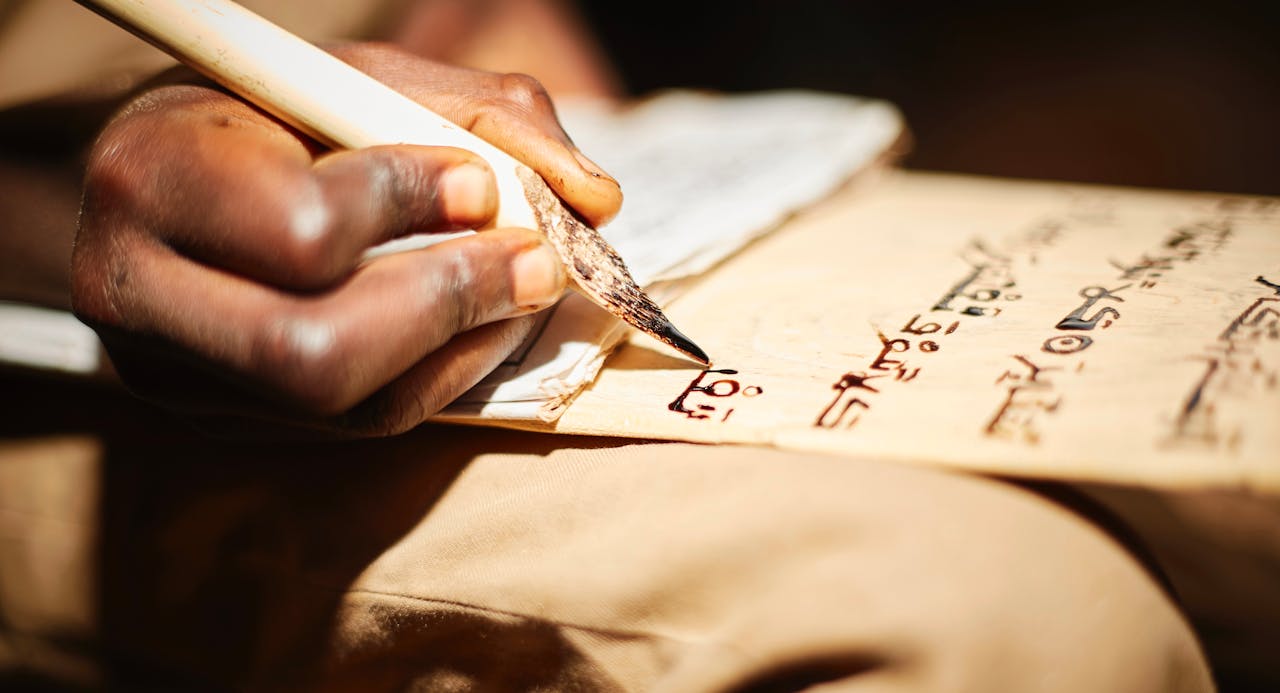
The earliest sentences weren’t born in scrolls or speeches—they were epigrams, etched as epitaphs on tombstones to mark a death. A good sentence on such a bleak theme can feel oddly cheering. By clothing despair in eloquence, it proves that suffering can be endured. The sentence builds toward its own end, sealed by a full stop, whispering that anything—even one’s passing—can be borne if a life holds meaning. A well-written one acts as an antidote to self-pity and banality, stating the obvious (“this person died, as we all will”) without cliché, or revealing something unobvious that rings true forever.
In the ancient world, these epigrams leaped from stone to papyrus, evolving into a full art form. Poets like Callimachus, the third-century BCE librarian at Alexandria’s Great Library, made a living as epigrammatopoios—epigram fashioners. His elegy for friend Heraclitus opens with a note-perfect line: “Someone told me of your death, Heraclitus, and it moved me to tears, when I remembered how often the sun set on our talking.”
Epics and epigrams rivaled as antiquity’s top forms. Giants like Virgil and Ovid rinsed their palates between sprawling works by crafting sharp epigrams. Callimachus’s go-to put-down? “Big book, big bore”—brevity itself, verb-free. By the first century CE, Martial refined it into a switchblade: a puncturing twist at the end. Writers discovered a sentence gains power from strong stress in its final words, lingering in the mind and rippling back over what came before.
Epigrams soon fit any occasion—birthdays, wine tastings, a young man’s first shave, chariot victories, or jabs at doctors and athletes. They adorned lanterns too, like Martial’s on a bedroom light: “A lamp am I, aware of your joy in bed: Do what you will, not one word will be said.” Each gave voice to its object, much like today’s cheeky notes on crisp packets or smoothie bottles: “Keep me in the fridge and shake me before pouring. Eat me. Wash me thoroughly.”
This taught the ancients to “turn a sentence,” enclosing a world’s meaning in scarce words by slashing redundancy. Beauty, as an ancient law holds, springs from economy—like a Shaker table’s clean lines or Federer’s forehand. Writer Walter Pater warned to dread “surplusage” as a runner dreads excess muscle. Students still plead their essays can’t shrink further.
To craft a sentence, gather these essentials: words; a feel for how they interlock; a tool and surface to make them visible, tipping them into another’s brain; and—often forgotten—memory.
Short-term memory holds thoughts for about 30 seconds, making language possible. To grasp a sentence, you must retain its start until the end. Jonathan Swift’s Struldbruggs, immortal curse-bearers in Gulliver’s Travels, can’t read for eternity—their memories fail to bridge a sentence’s beginning to its close.
Reading is juggling: words tossed up until the full stop lands them. Too convoluted, and it’s billiard balls, clubs, torches on a balance board—something drops, chaos ensues. You hold it in your head, but for readers to, you write it down. Now visible, it yields to tinkering impossible in thought alone. Words become malleable stuff, like a carver’s stone or potter’s clay. Writers wield keyboards and screens.
Fiddling with fonts—serif to sans, Garamond to Verdana, sizing from 16-point giants to tidy returns—isn’t displacement doodling. It makes writing visible again, piercing habit’s fog. You spot tritenesses and opacities shrunk from view. It previews how words hit the page or screen, your reader’s sole path. Typefaces shift tone (though they can’t save bad sentences). Words must travel through eyes, not just inner echoes.
Writing down lets you mold as an artisan. Yet pitfalls lurk: “since” means “because” or “after that time”; “while” means “although” or “during.” Stray prepositional phrases confuse—”I wrote my speech while flying to Paris on the back of a sick bag.” Even over-correction trips readers, like straining to avoid a split infinitive (wrongly deemed evil), spotlighting the strain.
Master the sentence, and you wield ancient power: economy that endures, twists that sting, voices that cheer even death.
Source : First You Write a Sentence.: The Elements of Reading, Writing … and Life by Joe Moran
Goodreads : https://www.goodreads.com/book/show/38470061-first-you-write-a-sentence
Read the Previous Article in the Series :






Leave a Reply